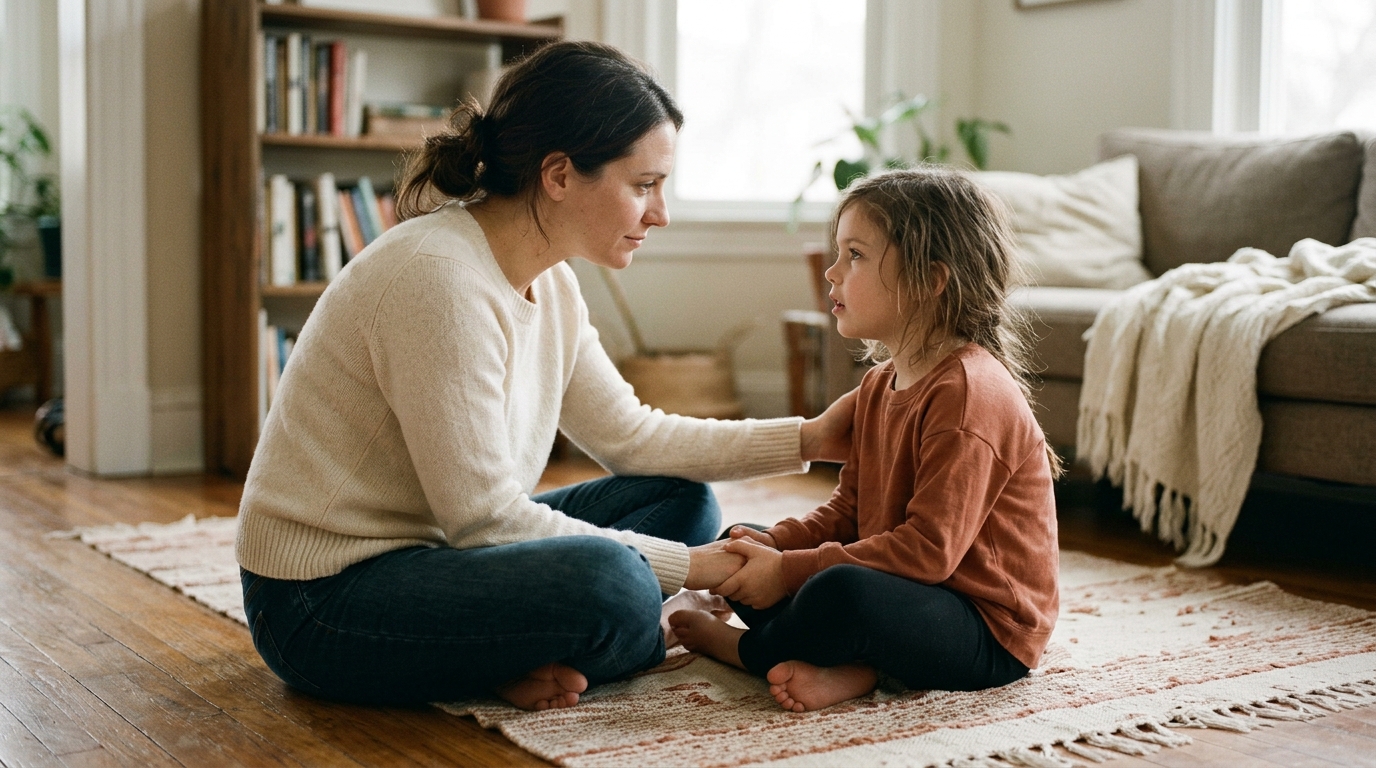
I used to think teaching my kids about emotions meant having calm, gentle conversations at appropriate moments. I would explain feelings the way a narrator explains a nature documentary, objective and composed. Then one Tuesday, my four-year-old threw a wooden block at her sister’s head, and I yelled louder than I have ever yelled, and suddenly the calm narrator was nowhere to be found.
After everyone had stopped crying, my daughter looked at me with red eyes and asked the question that undid me: “Mama, why are you so angry?”
I almost said what I always say. Something about how she should not throw blocks. Something about safety. But I was too tired to deflect, so I told her the truth: “I got scared. And sometimes when Mama gets scared, it comes out as angry.”
She stared at me for a moment. Then she said, “I was scared too.”
That was the first real conversation about emotions I ever had with my child, and it did not look anything like the parenting books said it would.
What I Was Getting Wrong
Before that day, I treated emotional education like a curriculum. Here is sadness. Here is what we do with sadness. Here is anger. Here is what we do with anger. I explained feelings the way I explain why we wear coats in winter — from a distance, with authority, never letting on that I was still figuring it out myself.
But children do not learn emotional intelligence from explanations. They learn it from watching the adults around them navigate their own feelings in real time. And what my kids were watching, for a long time, was an adult who pretended to have it together until she did not, and then exploded.
I was not teaching them about anger. I was teaching them that anger is something you hide until you cannot hold it anymore.
What I Do Now
I narrate my own feelings out loud, including the messy ones. “Mama is feeling really frustrated right now because the internet is not working and I need to finish something. I am going to take three deep breaths and try again.” This felt ridiculous the first dozen times. But now my four-year-old sometimes tells me, “Mama, maybe you need a deep breath?” Which is both humbling and useful.
I stopped trying to fix their feelings. When my daughter is upset, my instinct is to solve it. Distract her. Make it better. But I have learned that sometimes the most helpful thing is just to name what I see and let it be. “You seem really disappointed that we cannot go to the park. That makes sense. I would be disappointed too.” No fix. No rescue. Just company.
I apologize when I get it wrong. After I yell, which still. (Much like when I wrote about the guilt, this experiment gave me data I could not ignore.) happens, I sit down with whoever I yelled at and say exactly what I did and why I am sorry. Not “I am sorry, but you should not have done that.” Just “I am sorry I yelled. That was not okay. I was feeling overwhelmed and I handled it badly.” Modeling repair is more important than modeling perfection, because perfection is not an option any of us have.
What I Am Still Learning
Some days the emotional labor of parenting feels impossible. Helping small humans navigate feelings I am still learning to handle at forty years old. Watching them struggle with the same things I struggle with and knowing I cannot fix it for them, can only sit beside them in it.
But I have noticed something. The more honest I am about my own feelings, the more my kids talk about theirs. The fewer “I do not know”s I get when I ask how they are doing. The more they say things like “I feel wiggly inside” or “my heart feels heavy.”
I am not raising emotionally fluent children by being a perfect emotional role model. I am raising them by letting them see the real one. The one who gets angry and scared and sad and says so. The one who messes up and apologizes. The one who is still, at forty, learning how to take a deep breath instead of yelling.
Turns out that is enough. Not perfect. But real. And real is what they actually need.
Leave a Reply