I first heard the word “cozymaxxing” on TikTok at 11pm on a Tuesday, while I was answering work emails from bed. The irony was not lost on me.
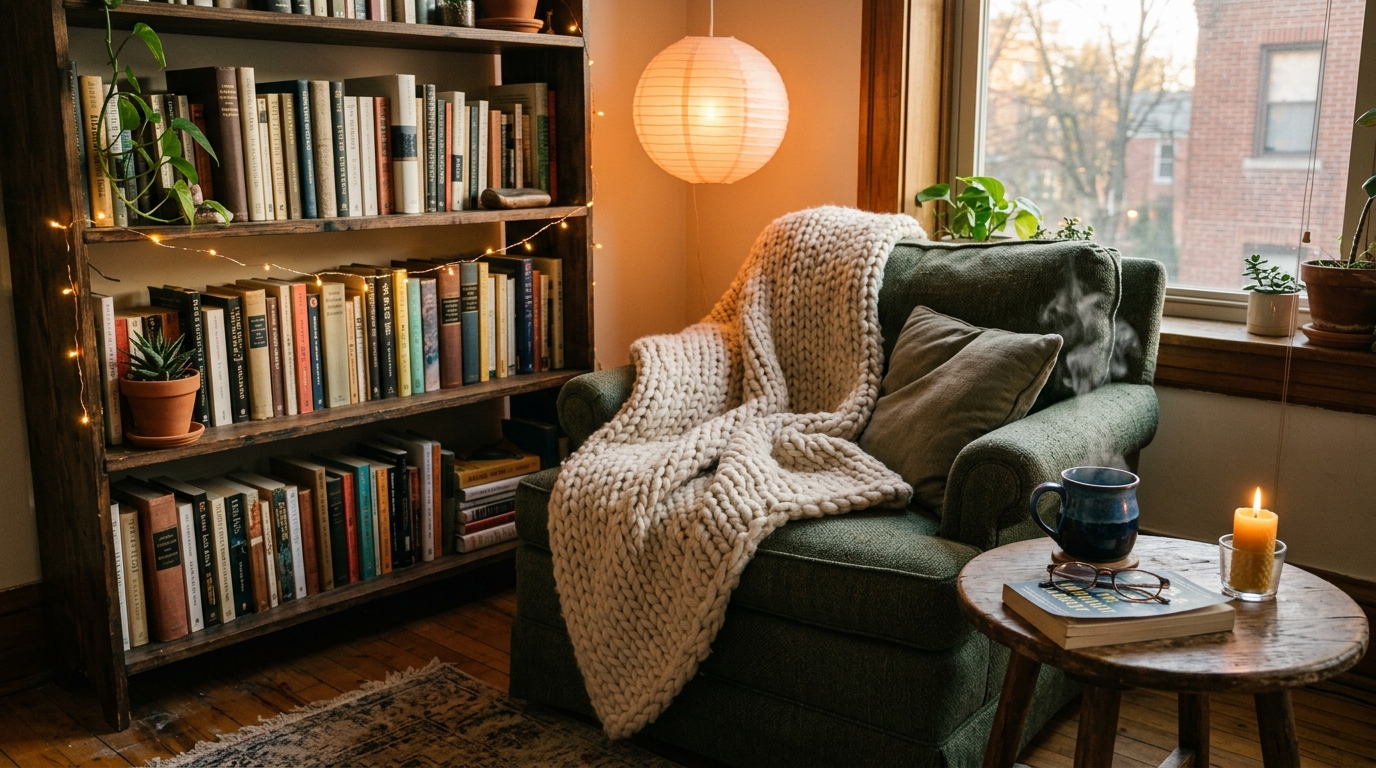
A creator was showing off her room — not a magazine-worthy living space, just a regular apartment corner she had turned into something soft and warm. There was a chunky knit blanket, a paper lantern casting that golden-orange glow you only get from non-overhead lighting, a mug of something steaming, and a small stack of books that looked like they had actually been read. The caption said something like: “cozymaxxing my space because the outside world is too much.” I watched it twice. Then I got up and turned off my big light.
What Cozymaxxing Actually Is
Cozymaxxing is the practice of intentionally making your environment as comfortable as possible, using sensory-rich, self-soothing elements that signal safety to your nervous system. It started on TikTok and YouTube in early 2025 and has since been covered by Martha Stewart, Forbes, and Good Housekeeping, not because it is complicated, but because it is the opposite. The core idea is simple: layer several comfort-focused rituals and objects until your space feels like a sanctuary, not a productivity station.
The name itself is a mashup of “cozy” and “maxxing,” a suffix borrowed from internet subcultures that means optimizing or maximizing something. But unlike looksmaxxing or studymaxxing, cozymaxxing does not ask you to grind harder. It asks you to stop.
Martha Stewart’s team describes it as “the practice of engaging in multiple self-soothing activities that center around your senses and embody the true essence of comfort.” There is no wrong way to do it, as long as what you are doing brings you calm.
Not Hygge — Cozymaxxing Is Maximalist
If you have heard of hygge, the Danish concept of creating warm, simplified atmospheres, cozymaxxing might sound familiar. But they are not the same thing. Hygge leans minimalist: declutter, simplify, keep things clean and intentional. Cozymaxxing goes the other direction. Think of it as hygge on steroids. You are not subtracting to find calm; you are adding blankets, candles, textures, soft things, warm drinks, ambient sounds, low lighting, layering comfort until it wraps around you like a weighted blanket.
Marketing firm Boxwood put it well: cozymaxxing “has a more maximalist bent that embraces collecting and layering rather than decluttering and simplifying.” For those of us whose homes will never look like a Scandinavian design catalog, this is genuinely freeing.
Why Cozymaxxing Is Having a Moment Right Now
There are several reasons this trend caught fire. People are burned out. Therapists and psychologists note that after years of economic uncertainty, pandemic aftershocks, and the always-online culture, many people are searching for small pockets of peace rather than grand life overhauls. Ken Fierheller, a registered psychotherapist at One Life Counseling, told Healthline that “people are burnt out and looking for ways to create little pockets of peace in their lives.”
There is also a quiet rebellion against hustle culture happening here. In a world where people are told to maximize their productivity, their skincare routine, their workout schedule, their side hustle, cozymaxxing says: maximize your comfort instead. Ritika Suk Birah, a counseling psychologist, points out that “people are increasingly rejecting the glorification of busyness and hustle culture, opting instead for self-care and balance.”
I have written before about how I finally stopped burning out, and I recognize this shift. The most countercultural thing you can do right now might be to rest deeply, on purpose.
The Science Behind Soft Lighting and Chunky Blankets
This is the part I did not expect: cozymaxxing actually has some research behind it. Studies show that creating a comforting sensory environment can lower cortisol levels, improve heart rate variability, and help activate the parasympathetic nervous system, the part of your body responsible for rest, digestion, and recovery. Soft, warm lighting in particular signals to your brain that it is time to wind down, which is why overhead fluorescent bulbs feel so aggressively wrong after 8pm.
Multiple researchers have pointed out that sensory self-soothing is not just a nice-to-have; it is a legitimate stress management tool. Engaging your senses through touch (soft fabrics), smell (candles or essential oils), sight (warm lighting), and even taste (a warm drink), anchors your attention in the present moment. It is essentially a low-effort form of grounding, the same technique therapists teach for managing anxiety.
One review noted that regular engagement in comfort rituals is associated with lower resting cortisol and improved sleep quality. You do not need a spa membership. You need a soft blanket and permission to use it.
My Own Attempt at Cozymaxxing (Spoiler: It Was Awkward at First)
The first night I tried cozymaxxing, I felt a little silly. I lit a candle my sister gave me two Christmases ago. I made tea instead of opening my laptop again. I turned off the big light and switched on a small lamp with a warm bulb. I put my phone in another room, and this part was genuinely uncomfortable for the first five minutes.
Then something happened. My shoulders dropped. I noticed my jaw had been clenched. I sat there doing nothing productive for maybe twenty minutes, and when I went to bed, I fell asleep faster than I had in weeks.
I kept doing it. Not every night; I am not that disciplined. But enough times that I started looking forward to my little cozymaxxing routine. It became a signal: the day is over, you are allowed to stop now. For someone who has spent years feeling guilty about rest, that signal was worth more than any productivity hack I have ever tried.
How to Try Cozymaxxing Without Buying Anything New
You do not need to buy a reading nook or aesthetic candles. Cozymaxxing works with whatever you already have. The core principles are simple:
Lighting matters more than anything. Turn off overhead lights. Use lamps, fairy lights, or even just a candle. Warm-toned bulbs make a surprising difference. Texture comes next — grab the softest blanket you own, put on socks, sink into a cushion. Engage your senses: a warm drink, a familiar scent, some ambient music or silence. The point is not to curate a Pinterest board. The point is to tell your nervous system that right now, in this moment, you are safe.
Some people cozymaxx their entire apartment. Others cozymaxx a single chair in the corner. Both approaches count. I started with just my bedside setup, and even that small corner of intentional comfort changed how my evenings felt.
The walks I take every morning help me start the day grounded, but cozymaxxing helps me end it the same way. The two habits, oddly enough, work as a pair: one for morning regulation, one for evening unwinding.
Is Cozymaxxing a Trend or a Real Shift?
I think cozymaxxing sticks around because it does not ask for much. It is not a 30-day challenge or an expensive wellness program. It is just the recognition that your environment shapes your nervous system, and that making small, intentional changes to that environment is a legitimate form of self-care.
Will it cure burnout? No. Will it fix your sleep, your anxiety, or your overwhelm in one evening? Also no. But it might remind you what it feels like to be comfortable in your own space, and for a lot of us who have forgotten how to rest, that reminder matters more than we think.
How Ananta can help
Ananta is our self-care and journal app for Android: a short daily place to log your mood and sleep, read one affirmation, and keep a small routine going through a busy week. If the advice above sounds right but you know a paper journal will not survive past Tuesday, that is the gap Ananta is built for. It is on the landing page and on Google Play, and you can see all of our apps on the Apps & Products page.
Leave a Reply