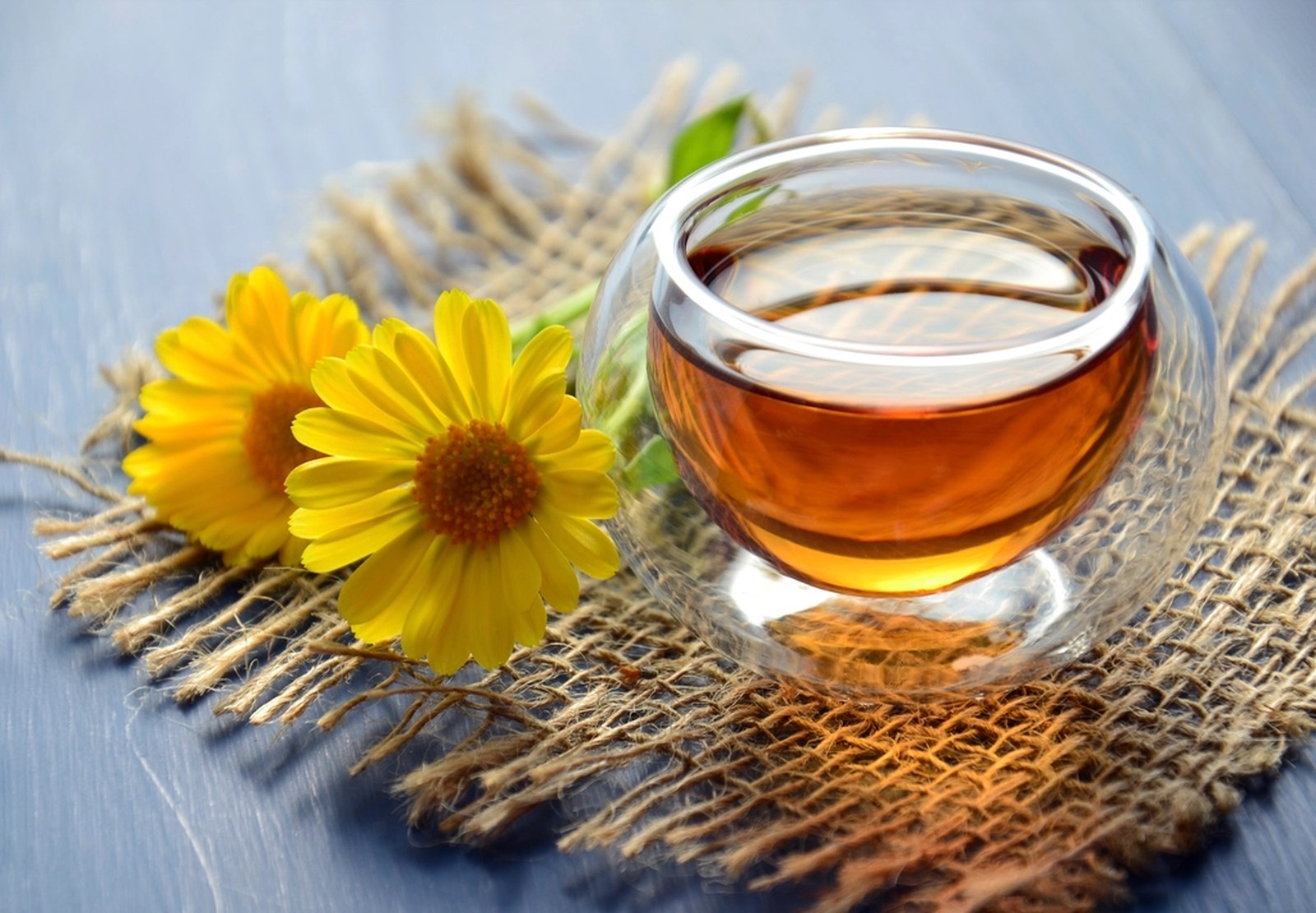
Movements you would normally shrug off can feel like a lot on day one. Every instinct says stay still until it passes. Ginger and chamomile are the two herbs most often suggested as tea for period cramps, and both have clinical trials behind them. The harder question is how much of the relief comes from the herbs, and how much from a warm mug and five quiet minutes.
Key takeaways
- Ginger beat placebo for period pain in two separate meta-analyses, and matched NSAIDs for pain intensity in one of them.
- Chamomile has a thinner evidence base: a 2021 review of seven trials found it eased pain and bleeding, but the trials were small.
- Cochrane rates the whole field as low or very low quality, mainly because the studies enrolled few women.
- Neither tea replaces heat, ibuprofen, or a diagnosis when pain interferes with your day.
- Chamomile can trigger allergic reactions in people sensitive to ragweed and daisies, and may interact with warfarin and birth control pills.
Why cramps happen at all
Cramps come from prostaglandins, chemicals your uterus releases to help it shed its lining. Higher levels mean stronger contractions. Those levels peak just before bleeding starts, then fall over the following days.
That timing explains why day one and day two usually hurt more than the rest of your period. Anything that lowers prostaglandin activity, including ibuprofen, tends to lower the pain.
What the research says about ginger
Ginger tea for period cramps is the version most people reach for, and ginger has the stronger evidence of the two herbs. A 2024 meta-analysis in the Journal of Integrative and Complementary Medicine pooled 12 studies. It found ginger reduced pain intensity compared with placebo, with a standardized mean difference of -1.13.
The same review found no meaningful difference between ginger and NSAIDs for pain intensity. Its authors also noted that safety data were rarely reported, which is a gap rather than a green light.
An earlier meta-analysis in Cureus looked at five placebo-controlled trials and two head-to-head trials against NSAIDs. It reported that ginger eased menstrual pain more than placebo, with a mean difference of 2.67 points on the pain scale.
Ginger and NSAIDs came out roughly equal for pain severity. That review found no clear effect on how long the pain lasted, and it flagged high statistical heterogeneity across the pooled studies.
What the research says about chamomile
Chamomile tea for period cramps rests on smaller studies. A 2021 systematic review in the International Journal of Community Based Nursing and Midwifery examined seven clinical trials. Together they covered 1,033 participants.
The authors concluded that chamomile can be considered effective for period pain and for reducing menstrual bleeding. The proposed mechanism is the one that made it a traditional antispasmodic: chamomile extract appears to cut prostaglandin and leukotriene production.
A 2025 randomized trial tested a chamomile and L-theanine drink taken daily for five days around the start of a period. Participants reported reductions of roughly 57 percent on a visual analogue pain scale. That drink was not plain chamomile tea, and it had only 15 people per group. Read the result as promising for a chamomile-based drink, not as proof for the teabag in your cupboard.
How to make tea for period cramps at home
No trial tested one standard cup, so there is no research-backed recipe to copy exactly. What the studies used was a range: capsules, ginger powder, and brewed drinks, taken across the first few days of bleeding. For the tea version, steep a teaspoon or two of dried ginger, or a chamomile teabag, in hot water for five to ten minutes. Ginger is sharp, so start mild and see how your stomach answers.
Tea works best as part of the routine the NHS already recommends, not as a swap for it. That routine is a warm bath or shower, a heat pad wrapped in a towel against your tummy, a gentle massage, and some light exercise. If walking is your version of light exercise, the pacing matters more than the distance.
Who should be careful with these teas
Chamomile is likely safe at the amounts found in tea and food, according to the National Center for Complementary and Integrative Health. The same page flags a real risk of allergic reactions, including severe ones, in people allergic to ragweed, chrysanthemums, marigolds or daisies. It also reports interactions between chamomile and warfarin and some drugs processed by the liver.
Preliminary findings suggest chamomile may reduce the effectiveness of birth control pills. It may also worsen conditions that are sensitive to estrogen, such as breast or uterine cancer.
Ginger’s common side effects are digestive: abdominal discomfort, heartburn, diarrhoea, and irritation of the mouth and throat. That matters more if you already get reflux or have a sensitive stomach. Both NCCIH pages carry the same instruction, which is to talk to a healthcare provider before using either herb if you take any medication.
What tea cannot do
Cochrane’s 2016 review of dietary supplements for period pain is the honest counterweight here. It included 27 randomized trials covering 3,101 women, and judged all of the evidence to be low or very low quality. Most studies were small, ran in a single country, and recruited students in their late teens or early twenties.
The reviewers pointed to tiny sample sizes, missing methods, and inconsistent results. Ginger and chamomile tea for period cramps are reasonable extras alongside proven basics. They are not a treatment plan.
When to see a doctor
Period pain is common, and pain that stops you living normally is not something to push through with another cup of tea. Ask for an urgent GP appointment or call NHS 111 if your pain is severe or worse than usual and painkillers have not helped. Book a routine appointment if your periods become more painful, heavier or irregular, or if you bleed between periods.
Pain during sex or when going to the toilet also needs a doctor rather than a herbal remedy. Endometriosis, adenomyosis, fibroids and pelvic inflammatory disease all cause painful periods, and an IUD can cause cramps for the first three to six months after it is fitted.
How Lail can help
Tea is easier to time when you know your period is coming. Lail is a private period tracker for Android that keeps your cycle, symptoms, mood and weight on your own device, with no account and no cloud backups. Its insights also suggest foods for the phase you are in, which helps when you are working out what to drink and eat across the week.
Seeing which days you usually cramp lets you plan heat and a hot drink before the pain peaks. Lail is free with ads, and a premium tier of around Rp10,000 a month adds PDF export. You can also get it on Google Play.
FAQ
Does ginger tea work as well as ibuprofen?
In one meta-analysis, ginger and NSAIDs came out roughly equal for pain severity across the pooled trials. Those trials were small and inconsistent, so treat that as encouraging rather than settled.
How much ginger tea should I drink for cramps?
No trial has settled on a single amount, and the reviews note that safety data were rarely reported. Start with a normal cup and see how you feel instead of chasing a therapeutic dose on your own.
Can I drink ginger and chamomile together?
No trial has tested a blend of the two, so nobody can say whether combining them adds anything. Drinking them on separate days is the simpler way to notice which one helps you.
When is tea the wrong first move?
If the pain is severe, getting worse each cycle, or stopping you from working or studying, tea is not the answer you need. That pattern deserves a doctor, because conditions such as endometriosis and fibroids need treatment.
This article is educational and is not medical advice. Talk to a doctor or pharmacist about your own symptoms, and check with them before using herbal remedies alongside any medication.
Sources
- NHS. Period pain. https://www.nhs.uk/conditions/period-pain/
- Moshfeghinia R, Salmanpour N, Ghoshouni H, et al. Ginger for Pain Management in Primary Dysmenorrhea: A Systematic Review and Meta-Analysis. Journal of Integrative and Complementary Medicine. 2024. https://pubmed.ncbi.nlm.nih.gov/38770631/
- Negi R, Sharma SK, Gaur R, et al. Efficacy of Ginger in the Treatment of Primary Dysmenorrhea: A Systematic Review and Meta-analysis. Cureus. 2021. https://pubmed.ncbi.nlm.nih.gov/33842121/
- Niazi A, Moradi M. The Effect of Chamomile on Pain and Menstrual Bleeding in Primary Dysmenorrhea: A Systematic Review. International Journal of Community Based Nursing and Midwifery. 2021. https://pubmed.ncbi.nlm.nih.gov/34222539/
- Soh Z, Tan SC, Wong TH, et al. Effects of chamomile and L-theanine beverage on menstrual pain, menstrual symptoms, mood, and sleep quality in young women experiencing primary dysmenorrhea. Journal of Food and Drug Analysis. 2025. https://pubmed.ncbi.nlm.nih.gov/41525193/
- Pattanittum P, Kunyanone N, Brown J, et al. Dietary supplements for dysmenorrhoea. Cochrane Database of Systematic Reviews. 2016. https://pubmed.ncbi.nlm.nih.gov/27000311/
- National Center for Complementary and Integrative Health. Chamomile: Usefulness and Safety. https://www.nccih.nih.gov/health/chamomile
- National Center for Complementary and Integrative Health. Ginger: Usefulness and Safety. https://www.nccih.nih.gov/health/ginger