Author: Naya Bisa

  • I Finally Found Out Why I Always Feel Sleepy at 1 PM (and It’s Not Just Lunch)

    I Finally Found Out Why I Always Feel Sleepy at 1 PM (and It’s Not Just Lunch)

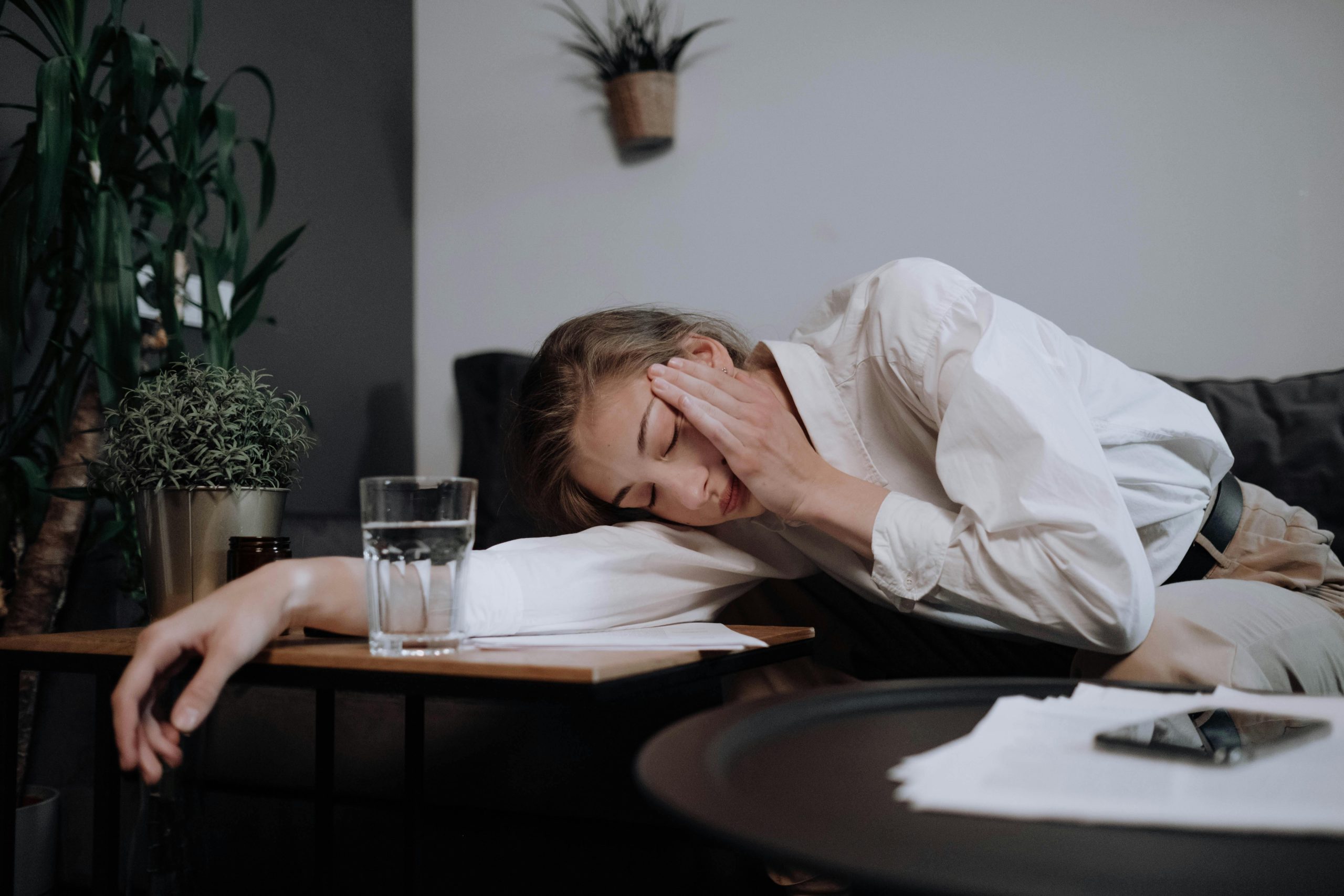
    Every day, somewhere between 12:45 and 1:15 PM, the afternoon slump hits. My eyelids start feeling like they have tiny weights sewn into them. My brain, which was firing on all cylinders ten minutes earlier, suddenly starts buffering like a video on bad hotel Wi-Fi. And my body just wants to curl up under my desk and nap like a cat in a sunbeam.

    For years I blamed lunch. “It’s the rice,” I told myself. “Too many carbs.” And yes, what you eat matters. But when I finally got curious and started digging into what was actually going on, I realized the afternoon slump is both more interesting and a lot less about personal weakness than I had assumed.

    The Afternoon Slump Is Not Laziness. It’s Biology.

    Here is something nobody bothered to tell me: your body has a built-in energy dip programmed right into the middle of your day. It is called the circadian dip, and it is as natural as feeling tired at midnight. (The Sleep Foundation explains how circadian rhythms govern these daily energy cycles.)

    Our internal body clock, the same one that nudges us awake in the morning and winds us down at night, has two low-energy points in every 24-hour cycle. One hits around 2 to 4 AM, which explains why even night owls eventually crash. The other arrives between roughly 1 and 4 PM. During that midday window, your core body temperature drops by a fraction of a degree, and your brain releases a tiny pulse of melatonin, the same hormone that helps you fall asleep after dark.

    So when you are fighting to keep your eyes open during a 2 PM meeting, you are not weak. You are not undisciplined. You are a mammal doing what mammal bodies do.

    Scientists call this the “post-lunch dip,” but that name is misleading because the dip happens whether you eat lunch or not. Food makes it more noticeable since a carb-heavy meal pulls blood toward your digestive system and triggers an insulin response, which can amplify the drowsiness. But the underlying energy trough is your body clock doing its thing, not your sandwich staging a coup.

    What I Tried (and What Actually Helped)

    Once I stopped treating my 1 PM crash as a moral failing, I started experimenting. Some things did nothing. A few things genuinely shifted my afternoons. Here is what worked:

    1. I stopped eating lunch at my desk.

    For months I was shoveling food into my mouth while staring at a spreadsheet, and it turns out that was making everything worse. Not because of the food itself, but because my brain was getting zero transition between work mode and break mode. Now I eat somewhere else. The kitchen table, the balcony, the couch. Anywhere that is not the same 60 centimeters of desk I have been staring at since 8 AM. This sounds laughably basic, but that small physical shift tells my brain something important: we paused. We can resume.

    2. I added a five-minute walk right after eating.

    I used to roll my eyes at this advice. Then I tried it. A short walk helps your muscles pull glucose from your bloodstream more efficiently, which blunts the blood sugar spike that often follows a meal. Natural light, even on an overcast day, also sends a direct wakefulness signal to your brain. (I wrote more about this after I started walking every day without treating it as exercise.) I do not do anything ambitious. Just a loop around the block. Sometimes I do not even change out of my house slippers. The point is not exercise. The point is telling your system, “We are still awake, thank you very much.”

    3. I checked my water intake, and it was embarrassing.

    By 1 PM on a typical day, I had consumed exactly one large cup of coffee and approximately zero sips of actual water. Mild dehydration is one of the sneakiest contributors to fatigue, and most of us walk around slightly dehydrated without ever realizing it. Now I keep a bottle on my desk and aim to finish half of it before lunch. Some days I remember. Some days I do not. On the days I do, my afternoon brain feels noticeably less foggy.

    4. I stopped fighting the dip and started working with it.

    This shift changed more than anything else on this list. Instead of attacking my afternoon energy trough with more caffeine, more willpower, and more silent self-criticism, I started treating 1 to 2 PM as my light work zone. Tasks that need actual brainpower, like writing or planning or making decisions, I save for morning and late afternoon. (Related: I once tried to force myself into morning-person habits and learned to work with my natural rhythm instead.) The post-lunch slot belongs to email, admin, organizing files. The kind of work my brain can do on low-power mode.

    Giving myself permission to slow down during that window (a lot like what happened when I did a 48-hour digital detox), instead of treating it like a daily character test I kept failing, made me more productive overall. I was no longer burning energy thrashing against my own biology.

    So No, It’s Not Just the Rice

    The next time your eyelids start drooping at 1 PM, remember this: your body is not broken. It is running an ancient operating system that includes a scheduled rest period right in the center of the day. Entire cultures that practice midday rest understood this long before we turned lunch into a fifteen-minute desk race.

    You can tweak what you eat. You can move your body a little. You can drink some actual water instead of just coffee. Those things genuinely help. But the single most useful thing I did was stop treating my afternoon energy dip like a personal flaw that needed to be conquered.

    Some days I still want to nap face-down on my keyboard. The difference is, I no longer think that makes me lazy. It just makes me a human being with a human body clock, same as everyone else.


  • My Self-Care Routine Is Small and Boring — and That’s Exactly Why It Works

    My Self-Care Routine Is Small and Boring — and That’s Exactly Why It Works

    For most of my adult life, I thought self-care was something I had to earn. Like a treat for finishing everything on my list first. The problem was, my list never ended. And so self-care kept getting pushed to some imaginary Friday that never came.

    I’d scroll past women on Instagram doing their elaborate morning routines: lemon water, meditation cushions, gratitude journals with perfect handwriting, ten-step skincare. Fifteen minutes of content compressed into reels that made it look effortless. It wasn’t effortless for me. Every time I tried to copy one of those routines, I’d last maybe three days before collapsing back into bed fifteen minutes before my first meeting.

    So I stopped trying to be aspirational about self-care. I got embarrassingly practical instead. I built a simple self-care routine that actually works — not because it is optimized or photogenic, but because it fits into the cracks of my actual day. And that’s when things started to shift.

    I stopped trying to have a “morning routine”

    There was a period where I consumed every morning routine video on YouTube. The 5 AM club. The miracle morning. The billionaire morning routine that was supposed to change my life. I tried them. I failed them. I felt worse about myself after each failure, which is ironically the opposite of what self-care is supposed to do.

    What I have now is embarrassingly simple. I get up. I drink a glass of water because I read somewhere that dehydration makes you groggy, and I am already groggy enough. I stand by the kitchen window for maybe three minutes with my coffee. I don’t meditate. I don’t journal. I don’t do yoga flows or cold plunges. I just stand there, warm mug in hand, looking at the sky. Sometimes the sky is gray. Sometimes there’s a bird. That’s it. That’s the routine.

    The surprising thing: those three minutes actually shift something. Not because they’re magical, but because they’re mine. Nobody needs anything from me in those three minutes. Nobody is asking me questions. My phone is somewhere else. It’s the only part of my day where I don’t produce or consume or respond. I just exist. That sounds extremely cheesy, I know. But I’ve come to believe that for women who carry a lot of invisible labor, simply existing without output is a form of resistance.

    Skincare that’s actually about care, not about skin

    I wrote before about how I stopped buying skincare products and started actually caring for my skin. That realization kept growing. I noticed that what I valued wasn’t the result, clearer skin, smaller pores, whatever; it was the ritual. The sixty seconds at night where I wash my face and nobody can ask me for anything because my hands are wet and my eyes are closed.

    My skincare now is three steps: cleanser, moisturizer, done. No serums. No actives I can’t pronounce. No ten-step protocol that makes me feel like I’m prepping for surgery. Just warm water, something that smells slightly like oats, and two minutes of touching my own face gently. I think that last part matters more than the products. When was the last time you touched your own face with kindness?

    I used to roll my eyes at people who called skincare “grounding.” Now I kind of get it. It’s not about the skincare. It’s about the pause. The bathroom door closed. The noise of the day finally off. Nobody needing me for two whole minutes. For someone who spends most of her waking hours attending to other people’s needs, those two minutes feel almost illicit. Like I’m getting away with something.

    The journaling method that doesn’t ask me to be deep

    I’ve written about my journaling approach before, but here’s the part I didn’t say: I still have days where I write nothing. Sometimes a week goes by and my notebook stays closed. Old me would have treated that as failure. Current me understands that journaling works precisely because it doesn’t punish me for skipping it.

    My journal is not aesthetic. It’s a cheap spiral notebook I bought at a supermarket. The entries are messy. Sometimes it’s just three bullet points: “Tired. Had toast. Forgot to reply to Sarah.” That’s it. There is no deep reflection. There is no gratitude list. There is just a record of being alive that day. And somehow, looking back at those mundane entries feels more meaningful than any curated journal could. Because it’s real. It’s my actual life, not the version I’d present to an audience.

    I think we’ve overcomplicated journaling. We’ve turned it into another thing we’re supposed to optimize. Morning pages, shadow work prompts, five-minute gratitude sprints. All of that is fine if it helps you. But if it makes you feel like you’re failing at journaling — which is absurd, you can’t fail at writing your own thoughts — then it’s not serving you.

    Digital detox in small doses (because 48 hours is unrealistic most weeks)

    I did a proper 48-hour digital detox once and wrote about how it reminded me what boredom felt like. It was great. It was also completely unsustainable. I am a working mom with responsibilities that require me to be reachable. I cannot disappear into the woods for a weekend every month.

    What I can do is much smaller. Phone goes to another room during meals. No scrolling in bed — that one took months to actually stick. The charger lives in the living room now, not on my nightstand. On Saturday mornings I don’t check anything until I’ve had breakfast. Not email, not messages, not the news. The world continues spinning. Nobody has ever died because I replied to their message at 10 AM instead of 7 AM.

    These tiny boundaries with my phone feel almost laughable to describe. But the cumulative effect is real. I sleep better when I don’t scroll before bed. I’m more present at breakfast when my phone isn’t face-up on the table. And I notice , actually notice , how often I reach for my phone out of pure reflex. The reaching itself has become a signal. What am I avoiding? What feeling am I trying to escape? Usually it’s boredom. Or anxiety. Or the uncomfortable reality that there is nothing urgent to do and I don’t know how to sit with that.

    Walking for my head, not for my body

    I started walking every day last year, not to lose weight or hit a step goal, but because my thoughts had gotten too loud and I didn’t know what else to do. I still walk. Not every single day, let me be honest, but most days. Twenty minutes. No podcast, no music, no phone calls. Just walking.

    The walking itself isn’t the point. The point is that I’m not doing anything else. I’m not productive during the walk. I’m not multitasking. I’m not optimizing. I’m just moving my legs and looking at trees and letting my thoughts unspool. Half the time my brain is looping a song lyric I can’t get rid of. The other half I’m mentally drafting emails I’ll never send. Neither is particularly enlightened. Both feel surprisingly healing.

    There’s something about forward motion that helps my brain process backward things. I don’t know the science. I don’t need to. I just know that when I’m stuck on a problem or a feeling, walking tends to loosen whatever’s jammed. Even if I come home with no solutions, I come home a little less clenched. That counts.

    Self-care as permission, not punishment

    The biggest shift for me wasn’t adding habits. It was changing how I talked to myself about adding habits. I spent years framing self-care as something I needed because I was broken. “I should meditate because I’m so anxious.” “I should walk because I’m out of shape.” “I should journal because my thoughts are a mess.” Every “should” was a tiny indictment. Every self-care practice was a reminder of my inadequacy.

    That framing never worked. It just made self-care feel like another thing on the to-do list, another way I was falling short. The turning point came when I started thinking about it differently: not as fixing myself, but as being with myself. The three-minute coffee. The face washing. The walk around the block. None of these fix anything. They don’t cure anxiety or make me more productive or give me glowing skin. They just put me in the same room as myself for a few minutes a day. And that, I’ve discovered, is more valuable than any cure.

    I also had to get comfortable with the discomfort of not being needed. This sounds strange, but stay with me. For a long time, my sense of worth was tangled up with how much people relied on me. Taking time for myself felt like abandoning a post. What if someone needed me during those twenty minutes I was walking? What if an urgent message came while my phone was in the other room? The guilt was real. It still shows up sometimes.

    What helped: learning to say no without explaining myself. Not just to other people , to the voice in my head that insists I must always be available. I started treating my small self-care habits not as indulgences but as non-negotiables. The same way I wouldn’t skip brushing my teeth, I try not to skip my three minutes of morning silence. I don’t always succeed. But having the standard matters more than hitting it perfectly.

    What a simple self-care routine that actually works looks like

    My self-care is not impressive. Nobody would film a reel about it. It’s three minutes of standing by a window, two minutes of washing my face, twenty minutes of walking, and a notebook where I sometimes write “had toast.” It is aggressively boring. It doesn’t require special equipment or early wake-up times or a personality transplant. It costs almost nothing. It fits into the cracks of my day rather than demanding space I don’t have.

    And it works. Not because it’s clever or optimized, but because it’s doable. Because I don’t feel guilty when I miss a day. Because nobody can tell me I’m doing it wrong , there’s no wrong way to stand by a window. Because the bar is so low I can’t fail, and not-failing builds momentum, and momentum builds something that starts to feel a lot like actually caring about myself.

    If you’re reading this and your self-care routine is also small and boring and ungrammable , keep it. Guard it. Don’t let anyone convince you it’s not enough. The most sustainable self-care might just be the kind that doesn’t look like self-care at all.

  • I Quit Being the Family’s Unpaid Project Manager

    I Quit Being the Family’s Unpaid Project Manager

    Mental load in motherhood is the invisible planning, remembering, and anticipating work that keeps a family running. The moment I knew something had to change was unremarkable. A Wednesday evening. I was standing in the kitchen, stirring pasta sauce with one hand, scrolling through the school email about dress-up day with the other, mentally calculating whether we had enough milk for tomorrow’s breakfast, and also wondering if anyone had remembered to put the bins out. My husband walked in, looked at the stove, and said, “Smells good. Need any help?”

    I wanted to say yes. But the help I needed was not someone stirring the sauce. The help I needed was someone who already knew the school had sent a dress-up day email, who had already checked the milk situation, who had already looked at the bin calendar, and who had already added all of it to an invisible master list that I was the only person maintaining. Stirring the sauce was the easy part. The sauce was never the problem.

    If you are a mother reading this, you probably already know exactly what I am talking about. If you are not, let me try to explain what mental load actually feels like. It is not the physical chores. It is not the laundry or the dishes or the school run. It is the constant, low-hum awareness that you are the person who remembers everything, plans everything, anticipates everything, and notices everything. It is the brain that never stops scrolling through an invisible to-do list, even when the rest of the body is sitting down.

    Experts often describe mental load in motherhood as invisible cognitive labor: the planning, tracking, and remembering that happens long before a chore is visible. If you want a clinical explanation, the Cleveland Clinic breaks down mental load in a way that makes this hidden work easier to name.

    mental load in motherhood

    Mental load in motherhood is the list nobody sees

    Here is a partial inventory of what my brain was tracking on that Wednesday evening: the dress-up day theme (superheroes, and we did not own a superhero costume), the milk supply (low), the bin schedule (recycling, had I taken it out?), the fact that my daughter had mentioned her shoes felt tight three days ago and I had not scheduled a shoe-shopping trip, the birthday party next Saturday that needed a gift, the RSVP I had not sent, the pediatrician form sitting in my inbox, the fact that we were running low on laundry detergent, the fact that the washing machine had finished an hour ago and the clothes were still sitting there, the work deadline I had pushed to Friday, and the three texts from friends I had not replied to in over a week.

    None of this was written down. None of it was urgent in the five-alarm sense. But all of it was taking up space in my head, running quietly in the background like a dozen browser tabs that never close. And nobody else could see them. Nobody else even knew they were open.

    Mental load is not about who does more dishes. It is about who notices that the dish soap is running low, who remembers to buy more, who tracks which brand is on sale this week, and who knows that the new eco-brand gave someone in the family a rash last time. The actual washing of dishes is almost an afterthought. The cognitive work comes first, and it never, ever stops.

    Why mental load in motherhood made me the default everything

    I did not sign up for this role. Nobody handed me a job description titled “Family Project Manager: Unpaid, Unseen, Unending.” It happened gradually, the way it happens in most households. I was home more in the early baby months, so I learned the pediatrician’s phone number. I was the one who noticed we were out of nappies, so I started tracking inventory. I was the one filling out the daycare forms, so I became the keeper of all family administrative knowledge. One small responsibility stacked on another until I was, without any conscious decision, the operating system of the entire household.

    My husband is a good man. He does his share of visible work. He cooks. He does bath time. He vacuums on weekends without being asked. But here is the thing: he does these things when I tell him they need doing, or when they are too obvious to miss. He has never once woken up at 3 AM wondering if we scheduled the next dental checkup. He has never felt a low-level anxiety about whether the school permission slip deadline is tomorrow or next week. He does not carry the mental spreadsheet. And for years, I did not know how to explain that the spreadsheet was the actual work.

    Research calls this “cognitive labor” or “invisible labor.” It is the anticipating, planning, monitoring, and remembering that keeps a family running. And study after study shows that women carry a wildly disproportionate share of it, even in households where physical chores are split evenly. You can split the dishes fifty-fifty and still have one partner doing ninety percent of the thinking. The dishes get clean either way. But only one brain is slowly frying itself keeping track of everything else.

    The conversation I was afraid to have

    I put off talking about this for months. Partly because I did not have the language for it yet. Partly because I was worried it would sound like scorekeeping or complaining. “I do more invisible work than you” is not a sentence that lands well at dinner. But mostly I stayed quiet because I had internalized a belief that managing the household was simply my job. I was the mom. This was the gig. Stop whining and stir the sauce.

    That belief is common and it is corrosive. It turns invisible labor into a personal failure: if I am exhausted by the mental load, I must be bad at managing it. If I cannot keep all the tabs open without burning out, I must be weak or disorganized. The problem, framed this way, is always me. Never the system. Never the fact that one person cannot and should not be the sole memory bank for an entire family.

    When I finally talked to my husband about it, I did not start with blame. I started with an invitation. I told him: imagine you are managing a small company with multiple departments, except you have no admin staff, no project management software, and you are also expected to cook dinner for the whole team every night while maintaining a pleasant emotional atmosphere. That is what my brain feels like. I am not asking you to do more. I am asking you to carry some of the knowing. Not just the doing. The knowing.

    He sat with it for a minute. Then he said something that took me off guard: “I did not realize there was a whole second layer. I thought helping with the visible stuff was enough.” He was not defensive. He was genuinely surprised. And I realized that for years I had been running a parallel operating system that I had never shown him, and then resenting him for not knowing about it. That was not entirely his fault. It was not entirely mine either. It was the silent architecture of how our household had been built.

    What I actually changed

    Talking helped, but talking alone does not redistribute mental load. Here is what we did that actually made a difference:

    Instead of my husband “helping” with the kids’ schedules by driving to activities when I asked, he now owns the entire children’s calendar domain. He gets the school emails. He knows the dress-up days. He tracks the permission slips. I do not think about any of it. This was the single most freeing change. I learned this approach after realizing that our Sunday reset ritual had already shown us how much smoother things ran when we both knew the week’s landscape, not just me.

    We now keep a shared family calendar and a shared grocery list, but more importantly, we keep a shared “head space” note where either of us can dump things we are mentally tracking. “Need to book car service.” “Mum’s birthday is in three weeks.” “The dog is due for shots.” Getting these out of my head and into a shared space means I am not the only one who sees them. It also means I am not the only one who can act on them.

    When my kids or my husband ask me a question I do not need to be the expert on, I say “I do not know, can you check?” Not aggressively. Not as a punishment. Just honestly. I am not the family search engine. I am not the walking inventory of every item in this house. The more I refused to be the default answer key, the more everyone else learned to look things up themselves.

    This was the hardest one. I used to believe that if something fell through the cracks, it was exclusively my fault. Now I accept that some things will fall, and that is not a moral failing. The world does not end if we run out of the “right” snacks or if a permission slip gets turned in a day late. I had to let go of the Pinterest-perfect mother ideal to make room for a version of me that was actually sustainable.

    What happened when I let go

    Here is what surprised me most: my family did not fall apart. They stepped up. Not immediately, and not perfectly, but they stepped up. My husband started noticing things. Not because I trained him like a project management intern, but because when I stopped doing all the noticing, the gaps became visible to him too. He learned the school email rhythm. He learned which brand of milk the kids actually drink. He learned that bins go out on Wednesday night, not Thursday morning. He learned because he had to, and because I finally gave him the space to.

    I also noticed something about myself: I had more bandwidth for the things that actually mattered to me. My creative work. My friendships. My ability to sit on the couch and watch something without my brain running a parallel inventory of everything we were low on. I had been living inside a low-grade hum of anxiety for so long that I had stopped recognizing it as anxiety. It just felt like normal. It was not normal. It was exhaustion wearing a organized-person costume.

    There are still days when the mental load tilts back toward me. Old patterns are stubborn. But the difference now is that I notice it sooner, and I name it, and I ask for the load to shift. I am not the family’s project manager anymore. I am a partner in a household that is slowly learning to share the thinking, not just the doing.

    If any of this sounds familiar, let me say something I wish someone had said to me years ago: you are not failing. You are not disorganized. You are not bad at managing life. You are doing an invisible job that was never meant to be done by one person alone. The sauce will be fine. The bins will get taken out eventually. But your brain deserves rest as much as your body does. Maybe more.

  • I Believed Exercise During My Period Was Bad for Me (Turns Out I Had It Completely Wrong)

    I Believed Exercise During My Period Was Bad for Me (Turns Out I Had It Completely Wrong)

    The first time someone told me I should go for a run while I was on my period, I laughed. Was this person serious? I could barely drag myself off the couch, wrapped in a blanket with a heating pad pressed against my stomach, and they wanted me to jog? The idea sounded not just unpleasant but genuinely unsafe. For years I believed the same thing most women around me seemed to believe too: that exercising on your period was something you just did not do. Your body was going through something, and the responsible thing was to rest. Your body was going through something, and the responsible thing was to rest. It felt like common sense.

    Except common sense and science do not always agree. When I actually started looking into the research, I realized almost everything I believed about exercise and periods was either exaggerated, outdated, or flat-out wrong. What surprised me most was not just that exercise was safe during menstruation, but that it might actually be one of the best things you can do for yourself during those days. Here are the myths I had to unlearn. According to a large-scale study by Harvard, there is no physiological reason to avoid exercise during any phase of your cycle unless a doctor has told you otherwise.

    Myth 1: Exercising on Your Period Is Dangerous or Unsafe

    This is the big one, the myth that sits underneath all the others. A lot of women genuinely believe that menstruation is a time for complete physical rest. The truth is there is no medical reason to avoid exercise during your period unless you have a specific condition like severe anemia or endometriosis that your doctor has flagged. For most women, continuing to move is not just safe but actively beneficial. The American College of Obstetricians and Gynecologists recommends regular exercise throughout the entire menstrual cycle. A Harvard Apple Women’s Health Study found that exercise habits naturally fluctuate across cycle phases, but there is no evidence that exercising during the menstrual phase itself causes harm.

    Myth 2: Exercise Makes Period Cramps Worse

    I used to think the pelvic area was having a tough enough time already and the last thing it needed was me bouncing around. Turns out the opposite is true. Moderate exercise triggers the release of endorphins, your body’s natural painkillers. These endorphins do not just lift your mood; they directly counteract prostaglandins, the compounds responsible for those uterine contractions that cause cramping. Think of endorphins as your body’s built-in ibuprofen, except you generate them yourself by moving. A 2019 meta-analysis published in the Journal of Education and Health Promotion reviewed multiple studies and concluded that regular aerobic exercise significantly reduces menstrual pain intensity. The science is consistent on this one.

    Myth 3: You Should Only Do Gentle Stretching or Yoga

    Listen, if gentle yoga feels right for you on day one, do gentle yoga. I am not here to tell anyone to deadlift through their cramps. But the idea that you must limit yourself to low-intensity movement is not based on any physiological rule. Strength training, running, cycling, swimming — these are all fine if you feel up to them. In fact, some women report that their best workouts happen during menstruation. A 2025 study published in the Strength and Conditioning Journal found that there is no consistent evidence supporting the idea that women should periodize their training around their cycle. The researchers concluded that individual perception and how you actually feel on a given day matter far more than any blanket prescription about what phase of your cycle you are in.

    Myth 4: Exercising Increases Your Menstrual Flow

    This fear makes intuitive sense. More movement equals more blood moving around the body, right? But menstrual flow is not controlled by your overall circulation like that. It is the shedding of the uterine lining, a process governed by hormonal signals, not by how much you are moving your legs. Exercise does not increase the total volume of menstrual bleeding. Some women may notice a temporary sensation of increased flow right after a workout, but this is usually just gravity helping what was already in the uterus exit more quickly. The total amount does not change. If anything, regular exercise over time is associated with lighter, more regular periods because of its beneficial effects on hormone regulation and body composition.

    Myth 5: Working Out on Your Period Messes Up Your Hormones

    During menstruation, both estrogen and progesterone are at their lowest points in the cycle. This does have some effect on things like energy levels and even ligament laxity, which is why some women feel slightly more prone to joint discomfort during their period. But exercising does not disrupt your cycle or throw your hormones out of balance. If anything, regular moderate exercise supports a healthier menstrual cycle over time by helping regulate insulin sensitivity, managing inflammation, and maintaining a healthy body weight, all of which contribute to hormonal balance. The only time exercise becomes a hormonal concern is at the extreme end — very intense training combined with caloric deficit, which can cause amenorrhea in some athletes. That is a completely different scenario from going for a thirty-minute jog or a strength session during your period.

    Myth 6: Exercising on Your Period Will Make You Feel Worse

    This one is personal. I have had days where the thought of putting on workout clothes felt like someone asking me to climb a mountain. But here is what I noticed after I started experimenting: every single time I actually tried exercising on my period, even just a twenty-minute walk, I felt noticeably better afterward. Not transformed into a different person. Just less bloated, less irritable, and less trapped inside my own discomfort. There is a feedback loop here that is easy to underestimate. You feel bad, so you skip exercise. Skipping exercise makes you feel worse the next day. Breaking that loop even once changes how you experience the rest of your period. It is not about hitting personal records. It is about reminding your body that it is still capable of feeling good.

    So What Should You Actually Do?

    The honest answer is: whatever feels manageable. Some women feel terrible on day one and great on day three. Some feel the opposite. There is no universal schedule. The only rule that actually holds up is to listen to your body as it is today, not as you think it should be. If you have energy, use it. If you are exhausted, rest without guilt. The goal is not to prove anything. The goal is to stay connected to your body instead of checking out for a week every month.

    I still have days where my heating pad wins and the workout does not happen. The difference now is I do not believe I am doing my body a favor by staying still. I know the difference between needing rest and just assuming rest is the only option. That shift changed my entire relationship with my cycle. If you have been sitting on the sidelines during your period for years because someone told you exercise was dangerous or pointless, maybe give yourself permission to test that assumption. You might be surprised by what your body can actually do.

    I have also learned that walking every day, not for exercise but for my mind, turned out to be the thing that got me through the hardest period days without feeling like I was forcing anything. And when I finally stopped trying to be a morning person, I realized that forcing myself into rigid workout schedules was half the problem — my body already knew what it needed, I just was not listening.

  • I Missed My Husband Even Though He Was Right There

    I Missed My Husband Even Though He Was Right There

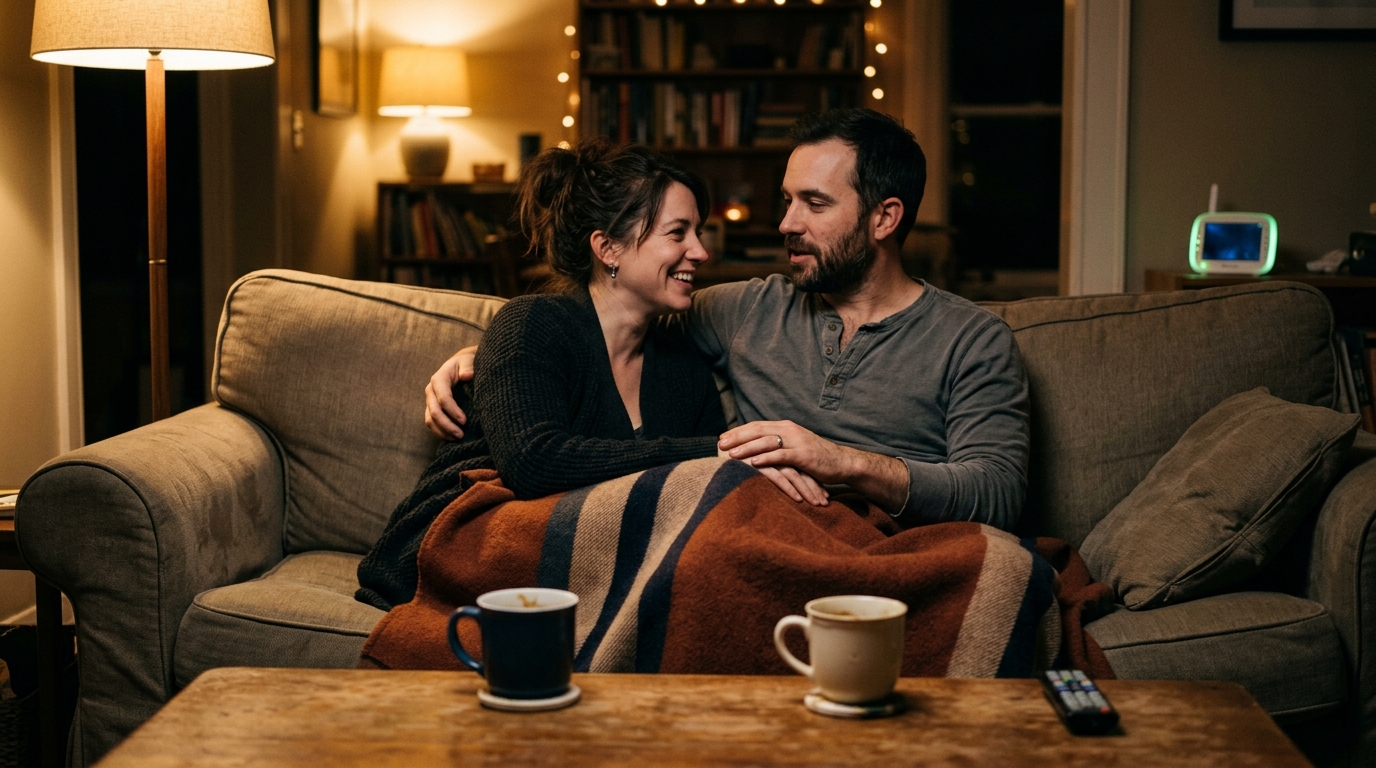
    We were sitting on the couch, both scrolling through our phones, the baby monitor humming between us. I looked at him, really looked, and thought: When was the last time we talked about something that wasn’t about the kids or the grocery list? I couldn’t remember. That was the night I realized the man I married had become someone I managed a household with, not someone I actually connected with. Keeping marriage alive after kids was something nobody had warned me about — it does not happen by accident.

    It didn’t happen overnight. Nobody wakes up one morning and decides to treat their spouse like a business partner. It happens in tiny, almost invisible steps. The first time you’re too tired for sex. The second time you skip date night because the babysitter canceled and you didn’t bother finding another one. The third time you choose sleep over a ten-minute conversation. After a few years of this, you look across the dinner table and realize you know exactly what brand of diapers they bought but you have no idea what’s been worrying them lately.

    The Gradual Disappearing Act

    With our first kid, we actually handled it okay. We were new parents, everything was exciting and terrifying, and we clung to each other like people on a life raft. We high-fived over successful naps. We whispered in bed after the baby fell asleep, dissecting every poop color and feeding pattern like scientists studying a fascinating new species.

    The second kid broke us. Not dramatically, not with a fight or a crisis. More like a slow leak in a tire you don’t notice until you’re driving on the rim. Suddenly there was no time for whispering in bed because two kids meant someone was always awake, always needing something. Our conversations shrank to logistics: who’s picking up, who’s dropping off, did you pay the preschool bill, do we need more wipes. Functional. Efficient. Completely devoid of anything that made us us.

    I started missing him even though he was in the same room. That’s a strange kind of loneliness, sitting next to your partner and feeling like you’re miles apart. I’d catch myself remembering what we used to be like before kids and feeling this ache that I couldn’t name. Grief, maybe. Grief for a version of our marriage that was spontaneous, curious, and occasionally irresponsible. The version where we could decide at 9 PM to go get ice cream just because, without calculating sleep schedules and car seat logistics.

    The Night I Realized Keeping Marriage Alive After Kids Takes Real Work

    The breaking point wasn’t a fight. It was worse. It was silence.

    One night after the kids were finally both asleep, my husband sat down next to me and said, “Hey. Are we okay?” And I opened my mouth to say “of course” because that’s the automatic answer, right? But the words wouldn’t come out. Instead, I just started crying. Ugly crying. The kind where you can’t talk because you’re too busy trying to breathe.

    He didn’t try to fix it. He just sat there and held my hand. And after I calmed down, we had the first real conversation we’d had in months. Not about schedules or responsibilities. About how we were both lonely, both exhausted, both convinced the other person must be fine since nobody was saying otherwise. We had been assuming silence meant everything was okay when it actually meant we had stopped trying.

    What We Tried (and What Actually Worked)

    I want to tell you we started weekly date nights, couples therapy, and regular weekend getaways. We didn’t. We had two small kids and a budget that didn’t stretch to babysitters twice a month, let alone therapy. All the relationship advice I’d ever read assumed resources we simply didn’t have.

    So we tried tiny things instead. Stupidly small, almost embarrassing to admit. We started a rule: after the kids went down, no phones for fifteen minutes. Just fifteen. Sometimes we talked. Sometimes we just sat there, exhausted, watching a show together. The point wasn’t the activity; it was the presence. Actually being in the same moment instead of escaping into separate screens.

    We also started a shared notes app on our phones called “Things I Noticed” where we’d leave small observations for each other. Nothing deep. “You handled that tantrum really well.” “That pasta thing you made was amazing.” “Thanks for letting me sleep in on Saturday.” It sounds cheesy, I know. I rolled my eyes at myself the first week. But reading those little notes, especially on hard days, reminded me that we were still seeing each other, still appreciating each other, even when we forgot to say it out loud.

    The thing that surprised me most? We started something I call “couch dates.” Once the kids were asleep, we’d make something simple together, like popcorn or instant noodles, and eat it in the living room watching a movie neither of us cared about. The movie was background noise. The real point was sitting next to each other in the dark, legs tangled under a blanket, just existing together without an agenda. Some nights we barely talked. Some nights we talked through the whole movie and had to rewind. Both versions counted as connection.

    It’s Not a Fix, It’s Maintenance

    I’m not going to tell you our marriage is now perfect. That would be a lie. We still have weeks where we’re basically coworkers who share a bed. The difference is I notice it sooner now. I recognize the feeling when it starts creeping in, that sense of drifting into parallel lives, and I say something instead of waiting for it to get worse.

    Here’s something nobody told me about keeping a relationship alive after kids: it’s not about grand romantic gestures or scheduled date nights or any of the advice that magazines sell at checkout counters. It’s about paying attention. It’s about turning toward your partner in those small moments instead of turning away. Someone once said a relationship isn’t sustained by the big decisions but by thousands of tiny micro-decisions every single day. That rings true for me in a way that “book a couples massage” never has.

    The other thing nobody mentions? You have to actually like your partner. Not love, like. Love can survive on obligation and history for a long time. But liking someone requires paying attention to them, finding them interesting, enjoying their company. After kids, it’s very easy to love your partner out of shared history while completely forgetting whether you actually like them as a person. That’s the question I ask myself now, on hard weeks: Do I like him today? If the answer is no, something needs to shift.

    When we started this whole attempt at reconnecting, I wasn’t sure anything simple could fix a drift that felt so big. But I’ve found that regular small rituals, like a Sunday reset, do more for connection than waiting for a romantic weekend that never comes. And when we do argue about something, which still happens plenty, I try to remember what I learned from the worst fight we ever had, that being right matters less than being kind. I’ve also realized that avoiding conversations about things like money doesn’t protect the peace, it just stores up tension for later.

    We’re Still Figuring It Out

    Last week I looked at my husband across the dinner table and he was telling me about something frustrating at work. Not in a complaining way, just sharing. I listened. He asked what I thought. We talked for forty-five minutes while the kids played in the living room, occasionally interrupting but mostly letting us have this weird, unexpected pocket of conversation. At some point I realized I was enjoying it, the conversation itself, not just the fact that we were talking. I liked him that night. I really did.

    According to research from the Gottman Institute, couples who maintain small daily rituals of connection after having children report significantly higher relationship satisfaction five years later. That’s the version of marriage after kids that nobody puts on Instagram. It’s not romantic getaways or surprise flowers. It’s sitting at a messy dinner table, talking about someone’s annoying coworker, and feeling genuinely interested. It’s catching yourself thinking yeah, this is still my person on a random Tuesday when nothing special is happening.

    If you’re in the thick of it right now, the phase where you’re basically roommates with a shared bank account and a parenting schedule, I don’t have advice for you. I can only tell you what I wish someone had told me: missing your partner while they’re sitting right next to you is not a sign your marriage is broken. It’s a sign you still care enough to notice the distance. The distance is fixable. It doesn’t take a vacation or a therapy fund. It takes one person saying “are we okay” and the other person being brave enough to tell the truth.

    We’re still figuring it out. Some weeks are good, some weeks we slide back into logistics mode. But the slide back is shorter now because we’ve built a habit of catching it. That’s the only difference between then and now: we pay attention. We say something. We try again.

  • I Deleted Every Productivity App on My Phone and Started Using a Notebook

    I Deleted Every Productivity App on My Phone and Started Using a Notebook

    I went through a phase last year where I was convinced the right app would fix my life. Not just improve it. Fix it. I downloaded Todoist, TickTick, Notion, Trello, Asana, Things 3, Sunsama, Structured, TimeTree, Forest, Habitica, and, in one particularly low moment, an app that literally paid me money if I stayed off my phone. I set up kanban boards at midnight while my kids slept. I configured reminders, tags, labels, priority flags. My Notion workspace had a dashboard so elaborate it could have managed a mid-sized startup. I was preparing to be productive. I was not, in any meaningful sense, actually being productive.

    The problem revealed itself quickly. Every notification, every satisfying checkmark sound, every badge telling me I had maintained a seven-day streak—all of it existed in a world where my environment was under my control. That world is not the one I live in. In my world, I write two sentences of a paragraph and a small voice behind me says “Mama, look” and I turn around to find my preschooler has put stickers all over the dog. In my world, I set a Pomodoro timer and the baby wakes up seven minutes in. In my world, the beautifully color-coded task list gets buried behind seventeen other open tabs because I had to Google “how to remove sticker residue from dog fur” in the middle of a work block.

    The apps were not the issue. The issue was that productivity apps are made for people who control their own time. I do not control my time. I negotiate it daily with two small humans who do not accept calendar invites. No app on earth can reschedule a toddler meltdown or push a diaper change to “later this week.”

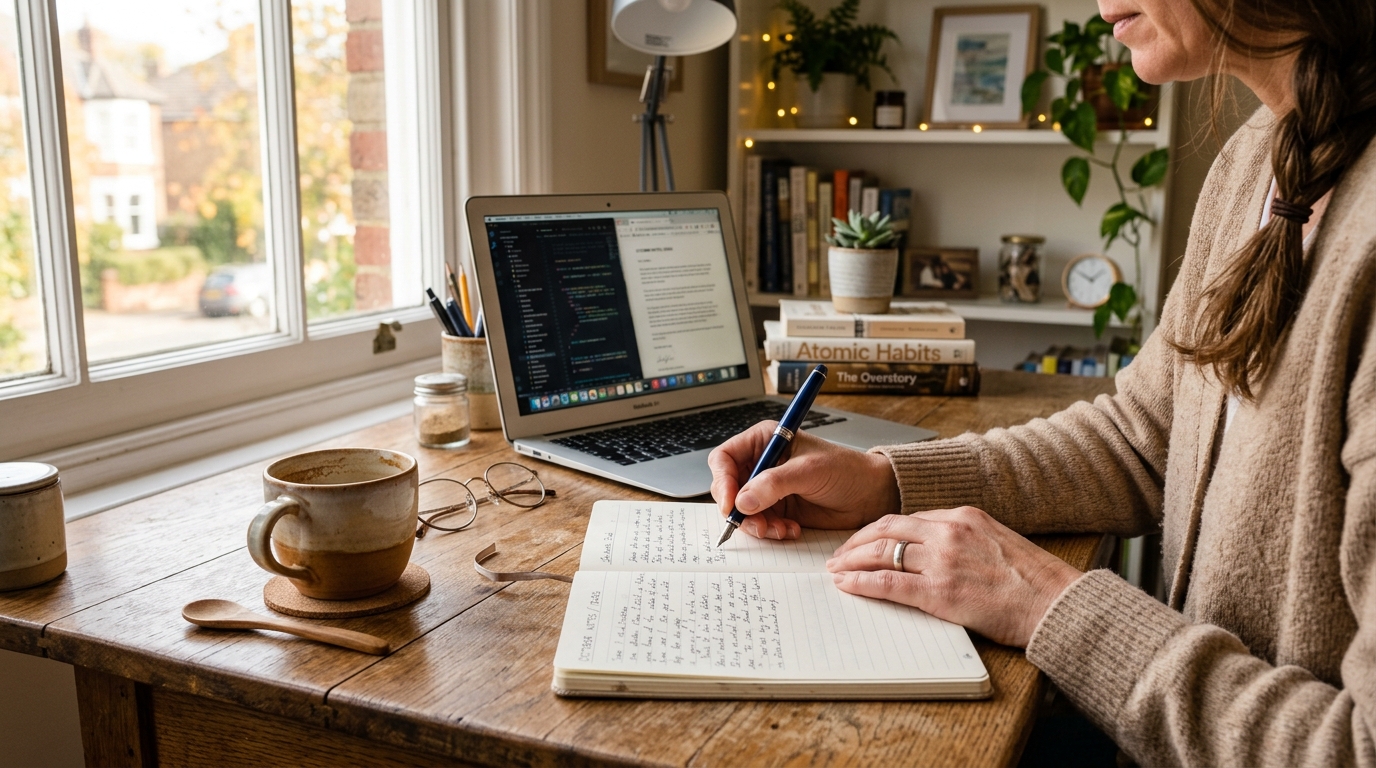
    So one afternoon, after a notification from Todoist let me know I was “behind on fourteen tasks” (as if I needed an app to deliver that news), I deleted them all. Every single one. The silence on my phone was disorienting for roughly three hours. Then I walked to the kitchen, grabbed my daughter’s notebook—the kind with a sparkly unicorn on the cover—tore out a page that had a crayon drawing of what I was told was a giraffe, and wrote down three things.

    Just three. That was the whole system.

    The unicorn notebook that outlasted thirteen apps

    The notebook cost me a dollar. It sends no notifications. It does not track my streaks or generate weekly reports. It lacks dark mode. It also does not make me feel like a failure every time I glance at it. That last part turned out to be the entire point.

    Here is what I landed on (and I use the word “system” loosely because calling it a system feels too generous):

    1. Three tasks per day, written the night before. Not fifteen. Not a matrix with four quadrants labeled urgent, important, delegate, and whatever else the internet wants me to believe I need. Three things. If I finish them before the kids wake from nap, great. If I finish them at 10 PM while eating cold rice straight from the cooker, also fine. The rule is simple: those three things push something forward that actually matters, and everything else can wait.

    2. One “if the universe cooperates” bonus task. This is the optimistic extra. If by some miracle naptime runs long, or my partner takes the kids to the park, or the planets align and nobody needs anything for forty-five consecutive minutes, I have one bonus task waiting. If it stays undone, it was never a promise. No guilt attached. No red badge counting silently against me.

    3. A one-sentence “day log” at the bottom of each page. Sometimes it says “Finished the client draft.” Sometimes it says “Nobody needed stitches.” Both count. This tiny habit replaced my old experiment with tracking every minute of my week, which was revealing exactly once and exhausting every time after. The one-sentence log answers the only question that matters: was today worthwhile? Almost always the answer is yes, even when the to-do list says otherwise.

    Why paper works when pixels didn’t

    Apps trigger something in my brain that I can only describe as dread-adjacent. When I open an app and see twenty tasks, fourteen of them overdue, my first instinct is not “let me tackle this.” My first instinct is to close the app and go fold laundry. Laundry has a clear finish line. Laundry does not judge me.

    The notebook does not trigger that reaction. There are three things on the page. Three things is not a mountain. Three things is barely a list. It is more like a suggestion, a quiet nudge from yesterday-me to today-me: “Hey, if you get to these, that would be nice.” There is no red text. No countdown clock. No passive-aggressive notification about a streak I broke because my kid had a fever and I prioritized correctly.

    Paul Graham wrote years ago about the difference between a maker’s schedule and a manager’s schedule. Makers need long uninterrupted blocks. Managers live in thirty-minute slots. Moms working from home with young children live in neither. We live in the cracks between other people’s needs. A five-minute window while the toast is toasting. Fifteen minutes of an episode of Bluey. The ten minutes after bedtime before collapsing onto the couch. The notebook thrives in these cracks. Apps demand you open them, wait for sync, read the notification, process the guilt. The notebook just sits there, already open to the right page, waiting.

    This philosophy has spilled into other parts of how I manage my time. I stopped batch-cooking entire weeks of food and started prepping ingredients instead: chopped vegetables in containers, marinated chicken in the fridge, rice in the cooker. The notebook equivalent of meal prep. When dinner time arrives, I assemble, I do not cook from scratch. Fifteen minutes instead of an hour. Same principle: lower the barrier, shrink the expectation, make it almost impossible to fail.

    What a real day looks like (not the curated version)

    I want to give you an actual day, not one I filtered for public consumption. Here was last Monday.

    Sunday night I wrote my three tasks: finish a blog draft, reply to four client emails, call the pediatrician about a prescription refill. The bonus task was to outline next week’s article.

    Monday morning my toddler woke up with a fever. Instantly the day reorganized itself around that one fact. The pediatrician call jumped from task three to the only thing that mattered. The draft got pushed without ceremony. Two of the four emails were urgent enough to send from my phone while I sat on the couch with a sick kid on my lap. The bonus task never had a chance, and that was fine because it was labeled “bonus” for exactly this reason.

    By 6 PM the scorecard read: one task complete (doctor called), one partially complete (two emails sent), one untouched (the draft), one bonus abandoned (the outline). The notebook did not scold me. It just sat there, unicorn and all, waiting for Tuesday.

    On Tuesday I moved Monday’s remaining items forward. I finished the draft by 10 AM while the feverish toddler napped. I sent the other two emails. The bonus got done. The world balanced itself out across two days instead of one, and nothing collapsed. No client fired me. No deadline was missed. The sky stayed exactly where it was.

    This is the thing that thirteen apps could not offer me: the ability to absorb a bad day without penalizing me for it. A system that understands some days are for surviving, not optimizing. The notebook has no opinion about whether Monday was a good day or a bad day. It just holds the list until I am ready.

    What surprised me

    I expected to feel less organized without my apps. I expected to miss deadlines and forget tasks and generally descend into chaos. The opposite happened. My anxiety dropped noticeably within the first week. Without the apps broadcasting everything I had not done yet, I had more mental bandwidth to actually do things. The background noise of obligation went quiet. I did not realize how much cognitive space those notifications were occupying until they were gone.

    I also did not expect to get more done, but I do. Three focused tasks that actually get completed beat twenty tasks I stare at while feeling guilty. I used to guard my two-hour work blocks with intensity because uninterrupted focus felt so rare and precious. I still protect those blocks, but now the notebook travels with me. I cross things off with an actual pen, and the physical act of drawing a line through a completed task is genuinely more satisfying than any app animation. I will argue this point with anyone.

    The other surprise was smaller but stuck with me: my preschooler sees me using the notebook, and now she has her own. She sits next to me sometimes and “writes her tasks.” Yesterday her list was: “1. Play dough, 2. Snack, 3. Find stickers.” She crossed off numbers one and two with ceremony. Number three stays pending, I think intentionally, because the hunt for stickers is ongoing and possibly eternal.

    If you want to try this

    Take a notebook from your kid’s art supplies, or grab the cheapest one at the store. Do not buy a fancy planner. Do not research “best notebooks for productivity” online for three hours first. The point is to start, not to optimize the starting conditions.

    Tonight, write three things. Not necessarily the three most urgent things. The three things that will make tomorrow feel like it mattered. Keep the notebook on the kitchen counter where you will actually see it in the morning. When you finish something, cross it off with whatever pen is nearby. If you do not finish, move it to tomorrow. No spreadsheet migration. No “weekly review.” No guilt.

    The productivity industry has built an entire economy around convincing you the solution is more. More features. More integrations. More granular data about how you spend every minute of your day. More ways to measure and optimize and track. My experience, after trying thirteen apps and landing on a child’s unicorn notebook, points in exactly the opposite direction. Less. Much less. Three things on a piece of paper, a pen that probably has a chewed cap, and permission to call it enough.

    I kept one app on my phone. It is not a productivity app. It is the app that pays me for staying off my phone. I have earned seventeen dollars so far. The irony is not lost on me, but I am spending it on more notebooks.

  • I Planned My Day in 30-Minute Blocks. My Toddler Had Other Plans.

    I Planned My Day in 30-Minute Blocks. My Toddler Had Other Plans.

    I downloaded three productivity apps in one afternoon. Color-coded my Google Calendar in pastels. Set up notification reminders at fifteen-minute intervals. Watched four YouTube videos about time blocking from people whose desks looked like hotel lobbies. I was going to become someone who has her life together, the kind of mom who runs a business, keeps a clean house, and somehow still bakes sourdough on Sundays. I lasted about four hours before my toddler unlocked a level of chaos I had not scheduled for.

    It was a Tuesday. I had everything mapped out: 9:00 to 9:30, deep work. 9:30 to 10:00, emails. 10:00 to 10:30, content writing. Each block had a color, a purpose, and a satisfying little chime to signal the transition. I felt like a CEO. At 9:12, my two-year-old walked into the room holding a half-empty bottle of cooking oil she had somehow retrieved from a cabinet I thought was child-locked. The oil was on the couch. The oil was on the floor. The oil was somehow on the ceiling. The time block did not survive.

    This is the part where productivity gurus tell you to wake up at 4 AM before your kids do. I tried that once. I was so tired by 2 PM I cried over a misplaced spatula. Not sustainable. Not human. Not for me.

    The fantasy vs. the living room floor

    Time blocking makes perfect sense on paper. You assign specific tasks to specific time slots, you protect those slots, and at the end of the day you have done things. It works beautifully when you control your environment. An office. A quiet room. No small humans with urgent opinions about snacks.

    But when you work from home with children, especially young ones, your environment is not yours. You are not the CEO of your own schedule. You are, at best, a middle manager who gets overruled by a tiny dictator every forty minutes. The preschooler needs a wipe. The baby woke up early from nap. Someone is crying and nobody knows why, including the person crying.

    I kept trying to force the system anyway. I would set up my blocks every Sunday evening, hopeful and delusional. By Tuesday morning, the calendar looked like a crime scene. Missed blocks everywhere. Half-finished tasks bleeding into the next day. I started feeling like I was failing at something that was supposed to help me succeed.

    It took me months to understand something obvious: the problem was not me. The problem was the system. Time blocking assumes linear time. Parenting is not linear. Parenting is a series of interruptions held together by snacks and hope.

    What I do now (and why it actually works)

    I did not abandon time blocking entirely. I just stopped treating it like religion and started treating it like a suggestion. Here is the version that survived my toddler:

    1. I switched from time blocks to “time zones.” Instead of thirty-minute precision slots, I now have three zones in my day: morning zone (creative work, if the universe allows), afternoon zone (lighter tasks, emails, admin), and evening zone (planning, or more realistically, collapsing). Each zone has one priority task. Just one. If I finish that one thing, the zone is a win. Everything else is bonus. I learned this approach after realizing that a two-hour block with one task did more for me than any color-coded schedule ever did.

    2. I stopped equating productivity with output. This was the hardest mental shift. Some days I write 800 words. Some days I write nothing but manage to schedule a pediatrician appointment, order groceries, and prevent someone from drawing on the walls. Both days are productive. They just do not look the same on paper.

    3. I built a meal prep system that does not need me to be Martha Stewart. I wrote about this before, but the short version: I prep ingredients, not meals. Chopped vegetables in containers. Marinated chicken in the fridge. Rice in the cooker. When dinner time comes, I assemble, I do not cook from scratch. It takes fifteen minutes instead of an hour, and it does not require a Sunday afternoon of batch cooking that makes me resent my own kitchen.

    These three changes did more for my sanity than any app, planner, or motivational podcast. And they hold up on the days when nothing goes according to plan, which is most days.

    A real day (not the Instagram version)

    Here is what last Wednesday actually looked like:

    6:30 AM: Woken up by a small person demanding “yellow cereal.” We do not have yellow cereal. We have never had yellow cereal. This is discussed at length.

    8:00 AM: Morning zone begins. I sit down with coffee. I write for twenty-two minutes before the baby monitor lights up. Nap over early. I save the document mid-sentence.

    9:30 AM: Snack negotiation. Then another snack negotiation because the first snack was rejected on grounds I still do not understand.

    11:00 AM: I get forty uninterrupted minutes while the toddler watches an episode of something with talking animals. I do not feel guilty about the screen time. The alternative is me losing my mind, which helps no one.

    1:00 PM: Afternoon zone. Emails. A phone call I have been avoiding. I reply to three messages while sitting on the bathroom floor because the toddler is in the bath and supervision is non-negotiable.

    3:30 PM: I attempt to fold laundry. I do not finish folding laundry. The laundry is still there as I type this.

    5:00 PM: Dinner assembly using pre-chopped vegetables from two days ago. Rice from the cooker. Some chicken I marinated that morning. It comes together in under twenty minutes. Nobody complains. This counts as a victory.

    8:30 PM: Kids are asleep. I stare at the wall for ten minutes, then write for an hour. The evening zone is real and it is sacred.

    This day produced maybe three hours of actual work. But it also kept two children alive, fed, and mostly happy. The old me would have called this day a failure. The current me calls it Wednesday.

    The productivity advice nobody gives moms

    Most productivity content is written by people with uninterrupted mornings and a door that closes. That advice falls apart the moment someone needs you to open a fruit pouch or find a missing shoe. I wasted a lot of energy feeling inadequate before I realized the advice was not built for my life.

    Your capacity is not fixed. It changes day to day, sometimes hour to hour. On days after bad sleep, yours or the baby’s, your brain works at half-speed. Expecting the same output every day is setting yourself up for guilt. Some days you flow. Some days you survive. Both are fine.

    Context switching is the real energy killer. This is why time blocking appealed to me in the first place, I wanted to protect deep focus. But when you are a mom working from home, context switching is the default mode. You go from writing a proposal to changing a diaper to answering a client email to breaking up a sibling argument, all in the span of twenty minutes. The cognitive cost of this is real, and you cannot optimize it away. What you can do is lower your expectations of what “focused” looks like on any given day, and stop comparing your scattered Tuesday to someone else’s silent office Friday.

    Rest is part of the work. I used to think resting meant I was lazy or undisciplined. Now I know that staring at the wall for ten minutes after the kids go to bed is not avoidance, it is recovery. My brain needs transition time between roles: mom, then worker, then human. You cannot sprint through all three without burning out. I learned that lesson the hard way.

    What I will keep and what I have let go

    I still use a to-do list, but it has three items maximum per day. Not fifteen. Not a “stretch list” for when I am feeling ambitious. Three things. If I finish them, the day is done. If I do not, they roll forward. No shame attached.

    I still protect my morning zone when I can, but I do not pretend it will always work. Some mornings the universe, or the toddler, has other ideas. On those days, I accept the chaos, find a pocket of quiet later, and try again.

    I stopped tracking every minute of my day. I did that experiment once and it was illuminating but exhausting. Now I track one thing: did I do the priority task? Yes or no. That is it. The rest is noise.

    The gift of letting go of perfect time blocking is space. Mental space. Emotional space. Space to notice that your kid is doing something funny with a cardboard box, or that the light through the window is pretty at 4 PM. These are not productivity metrics. They are life. And I was missing them while staring at my color-coded calendar.

    I still have the calendar app on my phone. I open it sometimes with genuine fondness, the way you might look at an old photo of yourself from a phase you have outgrown. The blocks are still there, faded pastels, reminders I never deleted. They do not rule my day anymore. They are just suggestions now. Preferences, not rules.

    And somehow, without the pressure of getting it right, I get more done. Not because I am more efficient, but because I am less paralyzed by the gap between the plan and the reality. The plan bends now. It used to break.

  • I Took Myself Out for Coffee Alone and Nobody Died

    I Took Myself Out for Coffee Alone and Nobody Died

    The first time I decided to leave the house without my kids, I made a list. A literal list. Emergency contacts, snack locations, nap time windows, the exact spot where the extra diapers lived, and a bullet point that just said “don’t forget she hates the blue sippy cup.” I handed it to my husband like it was a classified intelligence document. Then I stood at the door for five minutes. Then I came back inside to add one more note about the white noise machine.

    That list is still stuck to our fridge three years later. My daughter can read now. She asked me last week what “emergency protocols for meltdowns” means. I told her it’s a love letter.

    I didn’t actually leave that day. The list was my way of proving the house would collapse without me. See? Too many variables. Too many things only I know. Better stay. Better not risk it. And honestly, I believed that. The idea that my kids needed me in the building at all times felt less like anxiety and more like fact. That’s the voice of mom guilt, and it’s surprisingly convincing.

    The mom guilt math that kept me home

    Here’s the calculation that ran through my head every time I considered doing something alone: Cost of babysitter + cost of coffee + cost of guilt. The guilt always tipped the scale. I’d picture my kids crying. I’d picture my husband overwhelmed. I’d picture myself sitting at a cafe, unable to enjoy a single sip because my phone was face-up on the table, waiting for the emergency text.

    What kind of mother leaves her kids just to drink coffee?

    I asked myself that for two years. Two full years. And the answer I always arrived at was: not a good one. That was the story I told myself. It was effective and it was wrong.

    What shifted wasn’t some dramatic revelation. Nobody sat me down and told me I deserved a break. I just hit a wall. One Saturday morning, after the third consecutive night of broken sleep, I looked at my husband and said, “I’m leaving for an hour. I don’t know where. Text only if someone is bleeding.” And I walked out before I could talk myself out of it.

    The coffee that changed something

    I ended up at a small cafe about ten minutes from home. Close enough to sprint back if needed. Close enough that I could check “being reachable” off my anxiety list. I ordered a flat white and a pastry I didn’t need and I sat at a corner table facing the wall because I didn’t want to see families with kids. That felt too raw.

    The first ten minutes were weird. My hand kept reaching for my phone. My ears were tuned to phantom crying sounds. I checked the time six times. I was physically in a cafe but mentally still at home, running through the nap schedule and wondering if my husband had remembered that our youngest likes her blanket folded a specific way. (He didn’t. She survived.)

    Then something small happened. The coffee was actually hot. Not microwaved-three-times hot. Fresh hot. The pastry had layers. I noticed the music playing — some jazz thing I’d never choose at home because my kids would complain. I drank my coffee with both hands wrapped around the cup, the way I used to before I had kids, back when holding a warm cup was just holding a warm cup and not a luxury.

    Nobody interrupted me for 47 minutes. Nobody needed water. Nobody needed a snack. Nobody needed me to look at a drawing. Nobody needed anything from me, and I had genuinely forgotten what that felt like.

    What I didn’t expect

    I expected to feel guilty the entire time. I didn’t. The guilt showed up for about the first five minutes, mumbled something, and then got bored and left. What took its place was something I hadn’t felt in a long time — the simple pleasure of being alone. Not lonely. Alone. There’s a difference, and motherhood taught me exactly what that difference is. Research on parental burnout backs this up: chronic guilt doesn’t make you a better parent — it just makes you a depleted one.

    I also didn’t expect to come home to a functioning household. My husband had handled things differently than I would have. The kids ate lunch at 11:15 instead of 12. Our oldest was wearing mismatched socks. There were crackers on the floor. But everyone was alive. Everyone was calm. My husband had even managed to clean up the living room. I walked in and nothing was on fire, which felt like a personal victory.

    That’s the thing nobody tells you about mom guilt. It convinces you that only you can keep the ship afloat. That your specific way of doing things is the only way. But here’s what I saw that day: the ship floats without me. Maybe not as neatly. Maybe with more crackers on the floor. But it floats. And that was both liberating and slightly insulting.

    Why “me-time” is a bad name for it

    I hate the phrase “me-time.” It sounds like a marketing term for bath bombs and face masks. It sounds indulgent, optional, something you earn after you’ve completed all your real responsibilities. It’s the dessert of parenting — nice to have, but not essential.

    That’s wrong. The hour I spent at that cafe wasn’t pampering. It was maintenance. I wasn’t treating myself, I was refilling something that had been running on empty for so long I’d forgotten it needed fuel at all. There’s a huge gap between “treating yourself” and “functioning as a human being.” Moms get told the first one is nice but the second one is mandatory. We just don’t act like it.

    I stopped trying to be the mom who does everything perfectly a while ago, and that helped. But letting go of Pinterest-mom standards is only half the equation. The other half is actually doing something with the space that opens up. You can’t just stop performing. You have to start being.

    What I do now (and what I still can’t do)

    I go out alone once a week now. Sometimes it’s coffee. Sometimes it’s just sitting in a park for 20 minutes. Once it was buying groceries by myself at 9 PM, which might be the most peaceful grocery trip I’ve ever taken. I walked down every aisle slowly. I read labels. I didn’t rush. I’m aware this sounds sad. It’s not. It was glorious.

    I also started walking every day by myself. Not for exercise. Just to be outside without anyone asking me questions. That 20-minute walk has become non-negotiable in a way that surprised me. It’s the one thing in my day that doesn’t bend to someone else’s needs.

    But I’ll be honest: I still struggle with longer breaks. A weekend away? Haven’t done it. An evening out with friends that goes past 9 PM? Rare. There’s still a voice in my head that starts whispering around the two-hour mark. It’s quieter now, but it hasn’t shut up completely. I don’t know if it ever will.

    And I still have days where I skip my alone time because someone is sick, or there’s too much laundry, or I just don’t have the energy to advocate for myself. Those days happen. I used to beat myself up about them. Now I just try again tomorrow.

    The thing I wish someone had told me sooner

    Taking a break doesn’t mean you love your kids less. It doesn’t mean you’re selfish or ungrateful or bad at this. It means you’re a person who happens to be a mother, not a mother who used to be a person. There’s a difference.

    I wasted a lot of time thinking that being a good mom meant being physically present for every moment. That’s not true. Being a good mom also means being okay. It means not running on fumes. It means modeling for your kids that adults have needs too. My daughter watched me leave that day and come back calmer. She saw the before and after. And eventually, she started saying things like “Mama, you should go get coffee” when I seemed stressed. Kids notice. They notice more than we think.

    The coffee shop is still there. I still sit at the corner table. I still sometimes check my phone too many times. But I go. And every time I go, I prove to myself what I proved that first Saturday: the world doesn’t end when I step out of it for an hour. Everyone survives. Including me.

  • I Tried Cozymaxxing — The TikTok Comfort Trend That Told Me to Stop Hustling

    I Tried Cozymaxxing — The TikTok Comfort Trend That Told Me to Stop Hustling

    I first heard the word “cozymaxxing” on TikTok at 11pm on a Tuesday, while I was answering work emails from bed. The irony was not lost on me.

    A creator was showing off her room — not a magazine-worthy living space, just a regular apartment corner she had turned into something soft and warm. There was a chunky knit blanket, a paper lantern casting that golden-orange glow you only get from non-overhead lighting, a mug of something steaming, and a small stack of books that looked like they had actually been read. The caption said something like: “cozymaxxing my space because the outside world is too much.” I watched it twice. Then I got up and turned off my big light.

    What Cozymaxxing Actually Is

    Cozymaxxing is the practice of intentionally making your environment as comfortable as possible, using sensory-rich, self-soothing elements that signal safety to your nervous system. It started on TikTok and YouTube in early 2025 and has since been covered by Martha Stewart, Forbes, and Good Housekeeping, not because it is complicated, but because it is the opposite. The core idea is simple: layer several comfort-focused rituals and objects until your space feels like a sanctuary, not a productivity station.

    The name itself is a mashup of “cozy” and “maxxing,” a suffix borrowed from internet subcultures that means optimizing or maximizing something. But unlike looksmaxxing or studymaxxing, cozymaxxing does not ask you to grind harder. It asks you to stop.

    Martha Stewart’s team describes it as “the practice of engaging in multiple self-soothing activities that center around your senses and embody the true essence of comfort.” There is no wrong way to do it, as long as what you are doing brings you calm.

    Not Hygge — Cozymaxxing Is Maximalist

    If you have heard of hygge, the Danish concept of creating warm, simplified atmospheres, cozymaxxing might sound familiar. But they are not the same thing. Hygge leans minimalist: declutter, simplify, keep things clean and intentional. Cozymaxxing goes the other direction. Think of it as hygge on steroids. You are not subtracting to find calm; you are adding blankets, candles, textures, soft things, warm drinks, ambient sounds, low lighting, layering comfort until it wraps around you like a weighted blanket.

    Marketing firm Boxwood put it well: cozymaxxing “has a more maximalist bent that embraces collecting and layering rather than decluttering and simplifying.” For those of us whose homes will never look like a Scandinavian design catalog, this is genuinely freeing.

    Why Cozymaxxing Is Having a Moment Right Now

    There are several reasons this trend caught fire. People are burned out. Therapists and psychologists note that after years of economic uncertainty, pandemic aftershocks, and the always-online culture, many people are searching for small pockets of peace rather than grand life overhauls. Ken Fierheller, a registered psychotherapist at One Life Counseling, told Healthline that “people are burnt out and looking for ways to create little pockets of peace in their lives.”

    There is also a quiet rebellion against hustle culture happening here. In a world where people are told to maximize their productivity, their skincare routine, their workout schedule, their side hustle, cozymaxxing says: maximize your comfort instead. Ritika Suk Birah, a counseling psychologist, points out that “people are increasingly rejecting the glorification of busyness and hustle culture, opting instead for self-care and balance.”

    I have written before about how I finally stopped burning out, and I recognize this shift. The most countercultural thing you can do right now might be to rest deeply, on purpose.

    The Science Behind Soft Lighting and Chunky Blankets

    This is the part I did not expect: cozymaxxing actually has some research behind it. Studies show that creating a comforting sensory environment can lower cortisol levels, improve heart rate variability, and help activate the parasympathetic nervous system, the part of your body responsible for rest, digestion, and recovery. Soft, warm lighting in particular signals to your brain that it is time to wind down, which is why overhead fluorescent bulbs feel so aggressively wrong after 8pm.

    Multiple researchers have pointed out that sensory self-soothing is not just a nice-to-have; it is a legitimate stress management tool. Engaging your senses through touch (soft fabrics), smell (candles or essential oils), sight (warm lighting), and even taste (a warm drink), anchors your attention in the present moment. It is essentially a low-effort form of grounding, the same technique therapists teach for managing anxiety.

    One review noted that regular engagement in comfort rituals is associated with lower resting cortisol and improved sleep quality. You do not need a spa membership. You need a soft blanket and permission to use it.

    My Own Attempt at Cozymaxxing (Spoiler: It Was Awkward at First)

    The first night I tried cozymaxxing, I felt a little silly. I lit a candle my sister gave me two Christmases ago. I made tea instead of opening my laptop again. I turned off the big light and switched on a small lamp with a warm bulb. I put my phone in another room, and this part was genuinely uncomfortable for the first five minutes.

    Then something happened. My shoulders dropped. I noticed my jaw had been clenched. I sat there doing nothing productive for maybe twenty minutes, and when I went to bed, I fell asleep faster than I had in weeks.

    I kept doing it. Not every night; I am not that disciplined. But enough times that I started looking forward to my little cozymaxxing routine. It became a signal: the day is over, you are allowed to stop now. For someone who has spent years feeling guilty about rest, that signal was worth more than any productivity hack I have ever tried.

    How to Try Cozymaxxing Without Buying Anything New

    You do not need to buy a reading nook or aesthetic candles. Cozymaxxing works with whatever you already have. The core principles are simple:

    Lighting matters more than anything. Turn off overhead lights. Use lamps, fairy lights, or even just a candle. Warm-toned bulbs make a surprising difference. Texture comes next — grab the softest blanket you own, put on socks, sink into a cushion. Engage your senses: a warm drink, a familiar scent, some ambient music or silence. The point is not to curate a Pinterest board. The point is to tell your nervous system that right now, in this moment, you are safe.

    Some people cozymaxx their entire apartment. Others cozymaxx a single chair in the corner. Both approaches count. I started with just my bedside setup, and even that small corner of intentional comfort changed how my evenings felt.

    The walks I take every morning help me start the day grounded, but cozymaxxing helps me end it the same way. The two habits, oddly enough, work as a pair: one for morning regulation, one for evening unwinding.

    Is Cozymaxxing a Trend or a Real Shift?

    I think cozymaxxing sticks around because it does not ask for much. It is not a 30-day challenge or an expensive wellness program. It is just the recognition that your environment shapes your nervous system, and that making small, intentional changes to that environment is a legitimate form of self-care.

    Will it cure burnout? No. Will it fix your sleep, your anxiety, or your overwhelm in one evening? Also no. But it might remind you what it feels like to be comfortable in your own space, and for a lot of us who have forgotten how to rest, that reminder matters more than we think.

  • I Tried Yoga for Burnout — It Didn’t Fix Me, But It Did Something Better

    I Tried Yoga for Burnout — It Didn’t Fix Me, But It Did Something Better

    I tried yoga for burnout because I had run out of other options. Three months into what I now call my “great unraveling,” I found myself lying on a yoga mat in a dimly lit studio, crying quietly during savasana. I had started yoga because I was burned out. Not the casual, “I need a vacation” kind of tired. The kind where your brain fog gets so thick you forget why you walked into a room, where Sunday evenings feel like a countdown to doom, and where you snap at people you love over things that do not matter.

    woman practicing yoga for burnout recovery doing child's pose on a mat in dim studio

    I expected yoga to fix me. Spoiler: it did not. What it did was stranger and, honestly, more useful.

    I Thought Burnout Meant I Needed to Try Harder

    For most of my adult life, I operated on the assumption that feeling overwhelmed meant I was not working hard enough. So when burnout hit, I did what any overachiever does: I added more things to my schedule. More productivity hacks. Earlier mornings. A stricter to-do list. None of it worked, because burnout is not a motivation problem. It is a nervous system problem.

    Burnout happens when your body has been running on stress hormones for so long that it forgets how to turn off the alarm. Cortisol stays elevated. Sleep stops being restorative. Your brain treats a full inbox the same way it would treat a predator in the bushes. You are not lazy; you are physiologically exhausted.

    Multiple meta-analyses and pilot studies have confirmed what anyone who has tried yoga for burnout already suspects: yoga practice can measurably reduce stress, anxiety, and depressive symptoms. A growing body of research shows that yoga lowers cortisol levels and activates the parasympathetic nervous system, the part of your body responsible for rest, digestion, and actually feeling human again.

    The First Month Was Just Showing Up

    My first few sessions were humiliating. I could barely hold downward dog without shaking. My mind would drift to work emails during child’s pose. I kept waiting for the part where yoga would make me feel calm and glowing, like the women in yoga ads who seem to have their entire lives figured out. Instead I felt restless, stiff, and a little embarrassed.

    But I kept going back. Not because I loved it. Because it was the only 45 minutes of my day where nobody could ask me for anything, and that alone made yoga for burnout worth continuing. That alone, just being unreachable for three-quarters of an hour — was doing more for my burnout than any amount of planning or list-making ever had.

    Then something shifted. Around week five, I noticed I was breathing differently during the day. Not just on the mat, but during meetings, in traffic, when my kid was having a meltdown. My body had started remembering how to breathe from my diaphragm instead of my upper chest. I had not realized I had spent years breathing like someone being chased.

    What the Research Actually Says About Yoga for Burnout

    The literature on yoga for burnout does not claim yoga is a magic cure. What it does show is that yoga addresses burnout through multiple pathways at once: physical, emotional, and neurological. A review from the Kundalini Research Institute found that regular yoga and meditation practice reduced emotional exhaustion, one of the core symptoms of burnout, in healthcare workers and corporate employees alike.

    Breathing techniques, specifically, known as pranayama in yoga — appear to be one of the most effective tools for calming an overactive stress response. Slow, controlled breathing signals to your brain that you are safe. When you practice this repeatedly, your nervous system starts to recalibrate. You stop living in fight-or-flight mode as your default setting.

    This is not just a feeling. Studies show that yoga practice is associated with lower resting cortisol, improved heart rate variability, and reduced activity in the amygdala, the part of your brain responsible for fear and threat detection. In other words, yoga for burnout was physically changing how my brain responded to stress.

    Stronger Than I Expected, in a Different Way

    I thought yoga would make me flexible. It did, eventually, but that was never the point. What it actually did was teach me what it feels like to be in my body without trying to fix it or push it or optimize it. As someone who had spent years treating my body like a machine that needed to perform, this was genuinely uncomfortable at first. Stillness felt like failure.

    Over time, I started noticing things. My shoulders, which I had been carrying somewhere near my ears for approximately a decade, started dropping. I slept more deeply on nights I practiced, even if only for fifteen minutes. I became less reactive — not because I was trying to be Zen, but because my baseline stress level had actually gone down.

    I also stopped expecting yoga to solve my problems. It does not fix toxic workplaces or unmanageable workloads or the structural reasons women burn out at higher rates than men. What it does is give your nervous system a fighting chance. It creates small, reliable moments of regulation in a life that otherwise runs on chaos.

    The Yoga for Burnout Practices That Actually Helped (and the Ones That Did Not)

    Not all yoga is created equal when it comes to burnout recovery. Fast-paced vinyasa classes, the kind where you are jumping from pose to pose in a heated room, sometimes made me feel more wired, not less. Restorative yoga — the slow, supported, barely-moving kind — was the one that actually calmed my system down.

    Yin yoga, where you hold poses for several minutes, was helpful too. It taught me to sit with discomfort without immediately trying to escape it. That skill transferred off the mat more than I expected. Sometimes the answer to burnout is not doing less; it is learning to tolerate the uncomfortable feelings without spiraling.

    Breathing practices became my most-used tool. I started doing three minutes of alternate nostril breathing before bed. It felt silly at first, like something from a wellness influencer’s morning routine. But it worked. Within a week, I was falling asleep faster and staying asleep longer.

    Still Burned Out, Just Less Destroyed by It

    I want to be honest: I am not fully recovered. Burnout is not something you fix with a few months of yoga and some deep breathing. It is a long process of unlearning the habits and beliefs that got you there in the first place. My experiment with yoga for burnout did not cure me. It made me resilient enough to start addressing it from a place of regulation instead of survival.

    Some days I still feel fried. I still go for walks in the morning when my thoughts get too loud, and I still scribble in my journal on evenings when everything feels like too much. I still struggle with saying no and protecting my time. Yoga is not a replacement for those things. It is what makes those things possible.

    The difference is that I can now feel the burnout coming before it consumes me. My body sends signals: tight shoulders, shallow breathing, a low-grade irritation that sits just under the surface, and I actually notice them now. That might not sound like much. But when you have spent years ignoring your own limits until they forced you to stop, learning to listen is a kind of radical act.

    A Small Practice That Made a Big Difference

    If you are burned out and considering yoga for burnout, here is what I wish someone had told me: you do not need a 90-minute class. You do not need expensive leggings or a studio membership. You need maybe ten minutes, a quiet corner, and permission to be terrible at it.

    Start with child’s pose. Just two minutes, breathing slowly through your nose. That is it. If you want more, add a few gentle stretches. Cat-cow for your spine. Legs up the wall at the end of the day. Nothing fancy. Nothing that requires you to be good at it.

    Yoga did not fix my burnout. But it gave me back something I had lost: the ability to feel what was happening inside my own body. That turned out to be the first step toward everything else.