There is a moment in most cycles when what lands on the pad stops looking like a liquid and starts looking like something solid. Nobody explains it in advance, so it is easy to jump to the worst conclusion. Period blood clots are a normal part of a heavy flow, and the useful questions are how big they get and how often they appear. Knowing that turns a frightening sight into something you can measure.
Key takeaways
- Clots form when the flow is fast enough that the uterus cannot dissolve the fibrin mesh inside the blood.
- Small clots on your heaviest days are common and are not a problem in themselves.
- Period blood clots the size of a quarter or larger, more than once or twice a day, are one of the standard signs of heavy menstrual bleeding.
- Heavy bleeding is worth investigating mainly because it can slowly drain your iron stores.
- What feels like a very heavy period does not always match what gets measured, so track the details rather than the feeling.
What period blood clots actually are
Blood from a cut turns into a gel because fibrin forms a mesh through it. Menstrual blood usually does not, since the lining of the uterus is full of enzymes that dissolve that mesh as fast as it forms. When the flow is heavy, the dissolving system cannot keep up and some blood arrives already clotted.
At the same time, the uterus is working to stop the bleeding. Platelets clump at the exposed vessels, fibrin is deposited, and the muscle of the womb contracts to squeeze those vessels shut. A 2026 review of menstrual haemostasis notes that the flow conditions at the tiny spiral arteries which bleed during a period have never been measured directly, so the balance is still described in models.
One piece of this has been tested. Women with heavy bleeding do not break down clots faster in their bloodstream, which is why heavy periods are treated as a local problem in the endometrium rather than a clotting disorder.
What a normal amount of clotting looks like
The heaviest days are the ones that produce clots. NHS guidance describes a typical period as lasting 2 to 7 days, usually about 5, with the flow heaviest in the first 2 days and a total loss of roughly 20 to 90ml, or about 1 to 5 tablespoons.
The size thresholds used by clinicians all point the same way. NHS guidance flags clots larger than about 2.5cm, the size of a 10p coin, as one sign of heavy periods. The American College of Obstetricians and Gynecologists describes menstrual flow with blood clots as big as a quarter or larger. Cleveland Clinic lists clots the size of a quarter or bigger more than once or twice as a sign of heavy menstrual bleeding.
The size of your period blood clots is the detail worth noticing, more than their colour or texture. Smaller clots, appearing once or twice on your heaviest day, do not feature on any of those lists.
When period blood clots are worth checking
Period blood clots are a sign to act on when they come with a flow that disrupts your life. Any of these patterns is worth an appointment:
- Soaking through a pad or tampon every hour for several hours in a row.
- Needing a pad and a tampon together, or changing a pad every 1 to 2 hours.
- Bleeding that lasts longer than 7 days, even when the period blood clots themselves are small.
- Bleeding through to your clothes or bedding, or avoiding plans because of your period.
Heavy bleeding is not rare. About one third of women seek treatment for it, and Cleveland Clinic puts the share of people who menstruate affected by it between 27% and 54%.
What matters is the blood loss rather than the clotting itself. Losing more blood than your body replaces can drain your iron stores and lead to iron deficiency anaemia, which shows up as tiredness, shortness of breath and a faster heartbeat. Feeling weak and dizzy during your period is often the first visible sign of that iron dip. Avoiding exercise during your period is itself on the NHS list of signs, so putting your training on hold is a symptom rather than a solution.
What can cause larger clots
Most large clots are the visible end of a heavy flow. Fibroids, adenomyosis, endometriosis and polycystic ovary syndrome all appear on the standard lists, along with thyroid problems and, in the first year of use, the copper intrauterine device.
Inherited bleeding disorders are the cause that gets missed most often. Von Willebrand disease and platelet function disorders can present as nothing more than heavy periods, and a 2026 study of 235 teenage girls treated for iron deficiency anaemia found that 40.9% screened positive for von Willebrand disease after their iron levels were corrected.
Medicines can do it too, since blood thinners and aspirin increase menstrual bleeding. Heavy periods are also common in the years approaching menopause, when cycles become less predictable.
A small number of cases have a more serious cause. NHS guidance notes that heavy periods can rarely be a sign of womb cancer, and ACOG lists ectopic pregnancy and miscarriage among the causes.
Why “it looks like a lot” is not the same as a lot
How alarming your period blood clots look and how much blood you actually lose do not line up as neatly as you would expect. In a 2025 study, 79 people who described their periods as heavy had their loss measured, and the median was 66ml, with only about a quarter passing the 120ml threshold that defines heavy bleeding. Pad counts told a similar story: the heavy group used a median of 21.5 pads per cycle but still overlapped with those whose measured loss was normal.
That cuts both ways. Some people who dread their periods are bleeding inside the normal range, while others who think theirs are manageable lose more blood than they realise. A 2026 validation study found a photo-based method matched the laboratory standard closely enough to detect heavy bleeding with 100% sensitivity and 93.5% specificity.
How to track period blood clots before your appointment
It helps to bring numbers rather than adjectives. ACOG advises using a calendar or a period-tracking app to record several cycles before your visit, including the dates your period started, how long the bleeding lasted and whether the flow was light, medium or heavy. Cleveland Clinic adds the details that change what happens next: cramping, any bleeding between periods and any large clots you passed.
Three things are worth logging: the largest clot you passed, measured against a coin, the number of pad or tampon changes on your heaviest day, and how many days the bleeding lasted. If you would rather not hand your cycle history to a company, a private tracker keeps the log on your phone, which is the same information your doctor needs. There is more on cycle symptoms in our Cycle and Fertility archive.
When to see a doctor
Book a routine appointment if your periods have been heavy for a while, if they interfere with work, exercise or sleep, if you have severe pain, or if you bleed between periods or after sex. Post-menopausal bleeding always needs checking, and so does bleeding that is heavier than anything you have had before.
Seek urgent care rather than waiting if you are soaking through pads very quickly, if you feel faint, dizzy or breathless, or if you have severe pain that painkillers are not touching. If you are pregnant or might be, heavy bleeding with period blood clots should be assessed urgently.
How Lail can help
Lail is our own period tracker, built for exactly the kind of record a doctor asks for. It logs flow, symptoms, mood and weight, and keeps everything on your phone with no account and no cloud sync. Premium adds a PDF export you can take to an appointment, and the app is free to download with ads. Lail is on the Play Store, and you can see it with the rest of our apps on our products page.
Frequently asked questions
Are period blood clots normal?
Period blood clots are common, especially on your heaviest days, and a small one now and then is not a medical problem. What makes them worth checking is size and repetition rather than their presence. Clots around the size of a quarter, arriving more than once or twice a day, count as a sign of heavy menstrual bleeding.
How big is too big for a clot?
NHS guidance draws the line at about 2.5cm, roughly the size of a 10p coin, and ACOG uses a quarter as its comparison. Period blood clots that reach that size several times a day are worth mentioning to a doctor. One small clot on day one is a different situation entirely.
Can large clots mean a miscarriage?
Clots can be passed during a miscarriage, and heavy bleeding in early pregnancy is a reason to seek care the same day. That does not make every clot a sign of pregnancy loss, since fibroids, adenomyosis and plain heavy flow explain most of them. If you might be pregnant, treat large clots with pain as urgent.
Do clots mean I have a bleeding disorder?
Usually not, but bleeding disorders are under-diagnosed and heavy periods are often their only visible sign. Von Willebrand disease is the most common inherited one, and it turns up more often when a bleeding history is combined with a record of menstrual loss. That is one reason the clot sizes you note down are useful rather than fussy.
This article is educational only and is not medical advice. Cycle patterns vary widely, and only a qualified healthcare provider can assess your symptoms or decide whether you need tests.
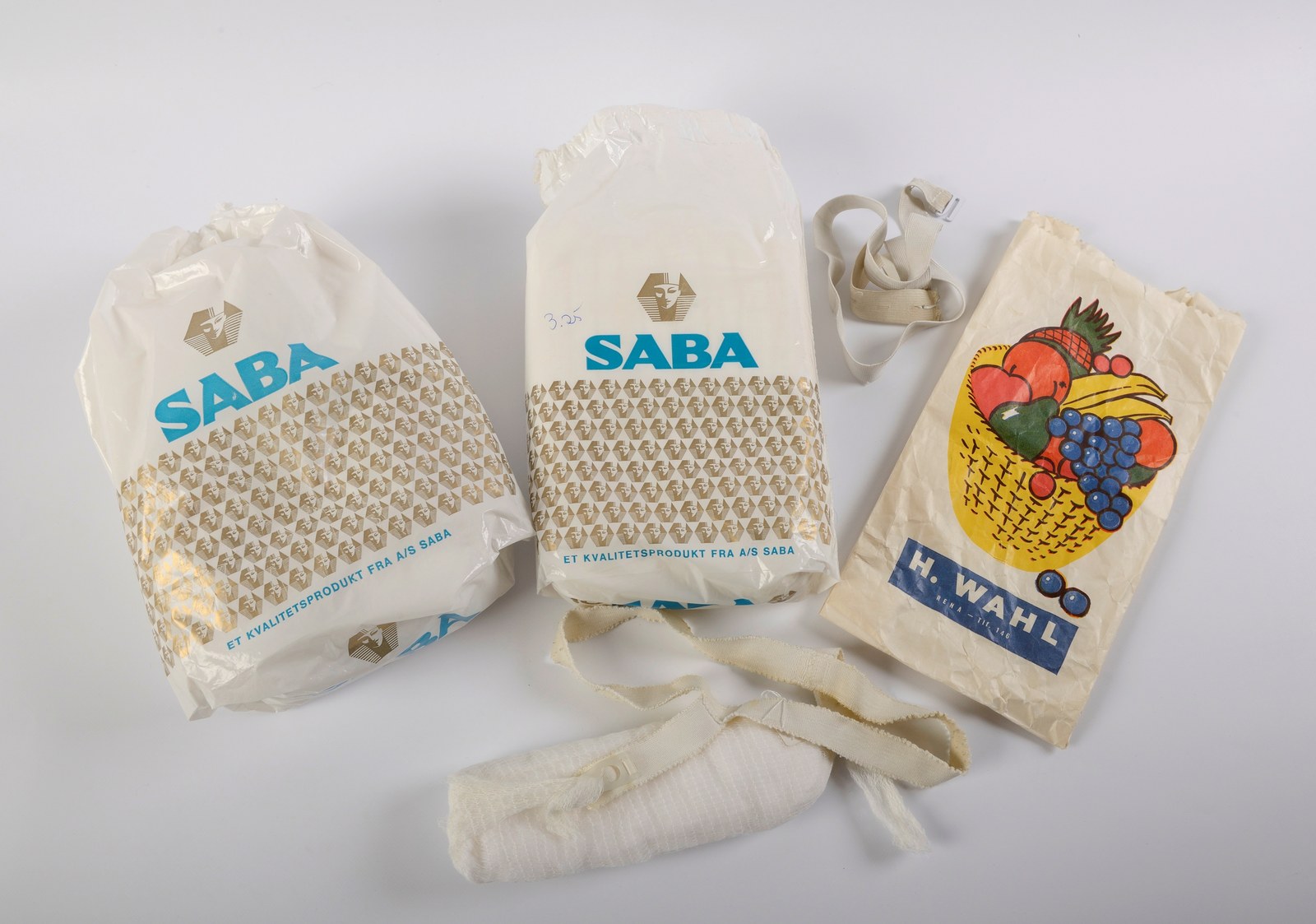
Featured image: “SABA damebind” by Geir Ove Andreassen / Anno Kvinnemuseet, CC BY-SA 4.0, via Wikimedia Commons (https://commons.wikimedia.org/w/index.php?curid=98467535).
Sources
- NHS. Heavy periods. https://www.nhs.uk/conditions/heavy-periods/
- NHS. Periods. https://www.nhs.uk/conditions/periods/
- NHS. Iron deficiency anaemia. https://www.nhs.uk/conditions/iron-deficiency-anaemia/
- The American College of Obstetricians and Gynecologists. Heavy Menstrual Bleeding. https://www.acog.org/womens-health/faqs/heavy-menstrual-bleeding
- Cleveland Clinic. Menorrhagia (Heavy Menstrual Bleeding). https://my.clevelandclinic.org/health/diseases/17734-menorrhagia-heavy-menstrual-bleeding
- Cleveland Clinic. Abnormal Menstruation (Periods). https://my.clevelandclinic.org/health/diseases/14633-abnormal-menstruation-periods
- Davies J, Kadir RA. Endometrial haemostasis and menstruation. Rev Endocr Metab Disord. 2012. https://pubmed.ncbi.nlm.nih.gov/23180227/
- Dodart R, Ku DN. What Stops Menstrual Bleeding? Hemostatic Mechanisms in the Menstruating Endometrium. Semin Thromb Hemost. 2026. https://pubmed.ncbi.nlm.nih.gov/42843808/
- Wiewel-Verschueren S, Knol HM, Lisman T, et al. No increased systemic fibrinolysis in women with heavy menstrual bleeding. J Thromb Haemost. 2014. https://pubmed.ncbi.nlm.nih.gov/24954113/
- Fahey J, Cachau-Hansgardh A, Parvataneni RK, et al. Association between menstrual pad usage, self-reported symptoms, and menstrual blood loss measured by the alkaline hematin method. Eur J Obstet Gynecol Reprod Biol. 2025. https://pubmed.ncbi.nlm.nih.gov/40543154/
- Turgutoglu Yilmaz A, Berk Akbeyaz B, Sahin Yilmaz M, et al. The Contribution of Bleeding Assessment Score and Pictorial Blood Loss Assessment Chart to the Diagnosis of Von Willebrand Disease in Adolescent Girls With Iron Deficiency Anemia. J Pediatr Hematol Oncol. 2026. https://pubmed.ncbi.nlm.nih.gov/42848004/
- Fahey J, Parvataneni RK, Waetjen LE, et al. Validation Study of a Photo-Based Menstrual Blood Loss Metric. O&G Open. 2026. https://pubmed.ncbi.nlm.nih.gov/41602783/