Day three, and the plan on your phone says heavy squats. Your body has filed a complaint. Training advice tends to swing between “push through it” and “stay in bed,” which leaves the boring middle unanswered. That middle is where the honest answer to which exercises to avoid during your period actually lives.
Key takeaways
- Periods are not a medical reason to stop training, and NHS guidance lists gentle movement such as walking, swimming, cycling and yoga among its pain-relief steps.
- The exercises to avoid during your period are the ones that spike your own symptoms: max-effort lifts, high-impact jumping, and long sessions in the heat.
- Heavy bleeding plus a hard training block is the combination most likely to drain your iron stores.
- A period that disappears while you train hard is a signal to get checked, not a badge of discipline.
- Stop mid-session if you feel faint, dizzy or flood through a pad in an hour, because those belong in a doctor’s office rather than a grit test.
What the research says about training on your period
Clinicians do not treat menstruation as a reason to stop moving. Cleveland Clinic notes that people who exercise tend to have less menstrual pain, and NHS period pain guidance names gentle exercise such as walking, swimming, cycling and yoga among its self-care steps. A 2024 Bayesian network meta-analysis of 33 randomised trials in BMJ Evidence-Based Medicine put exercise at roughly a three-point drop in pain intensity on a ten-point scale. The same review hedges, describing non-drug options as things that “may result in a reduction or slight reduction in pain intensity” and calling for larger trials.
The research is friendly, but it describes averages rather than your Tuesday. What shifts across a period is tolerance, not permission. Cramping happens when prostaglandin makes the uterus contract, and levels are highest around the start of bleeding, which is when the same workout can feel twice as heavy. Cleveland Clinic estimates that about 60% of people who menstruate get mild cramps, while 5% to 15% report pain severe enough to interfere with daily activities.
Exercises to avoid during your period
There is no medical list of banned movements, so treat any confident version of one with suspicion. In practice, the exercises to avoid during your period are the ones that make your own symptoms worse, and for most people that means changing the dose instead of cancelling the session. Here is where the adjustments usually land.
Max-effort lifting is the first thing to scale back. A one-rep-max deadlift or a session built on hard bracing asks for stamina and a steady core rhythm, and both are harder to hold on your heaviest days. High-impact work comes second: box jumps, sprint intervals and long downhill runs land hard when your pelvis already aches. Long sessions in the heat, hot yoga included, get rough fast when you are already lightheaded.
Yoga inversions deserve their own note. The rule that going upside down sends menstrual blood the wrong way is studio folklore, and NHS guidance does not single out any pose as one to stop. If inversions feel fine they are fine, and if they make you dizzy, that is the whole reason to skip them.
Anything a doctor has flagged outranks all of this. Endometriosis, a bleeding disorder, a history of anaemia or a heart condition each change the picture, and your clinician’s advice wins. Swimming is the classic case of an exercise people avoid for cultural reasons rather than medical ones, and NHS guidance names it as a way to ease period pain.
Why heavy bleeding and hard training are a poor pairing
Iron is where period training most often goes wrong. NHS says iron deficiency anaemia is usually caused by blood loss, and lists tiredness, shortness of breath, palpitations, pale skin and headaches among the signs. A 2018 review in the European Journal of Sport Science found that menstruating athletes, particularly those with heavy menstrual bleeding, carry a higher risk of iron deficiency. That matters twice in training, because iron carries the oxygen your muscles keep asking for.
Heavy bleeding has a working definition, and it helps to know where you sit. NHS counts changing a pad or tampon every one to two hours, using two products at once, periods longer than seven days, or clots bigger than about 2.5cm. A study of 30 female varsity athletes in Applied Physiology, Nutrition, and Metabolism found 20% were iron deficient, and that a higher menstrual loss score went with lower ferritin. If your flow is heavy and your training block is heavy, ask for a ferritin test instead of guessing.
Can training too much change your cycle?
Yes, and this is the part of the question where the risk is real and well documented. NHS lists “doing too much exercise” among the common causes of missed or late periods, alongside sudden weight loss and stress. Sports medicine describes the same pattern through low energy availability: burn more than you take in for long enough and the hormonal signal driving your cycle weakens. A 2019 review in Sports Medicine sets out how that plays out across menstrual function and bone health, and notes there is no single energy threshold where it starts.
The distinction that matters is sustained under-fuelling against one hard day. A brutal session on day two will not stop your period, but months of eating too little around hard training can. A 2026 narrative review in Frontiers in Sports and Active Living, drawing on 151 studies, describes menstrual dysfunction as a clinical barometer of energy deficiency and links it to weaker bone density over time. Missing periods has plenty of other causes, so treat it as a reason for a check-up rather than a self-diagnosis.
What to do on the days you feel awful
Scale intensity and keep the habit. A twenty-minute walk, an easy spin, a swim or a mobility session keeps your routine intact and often eases cramps. NHS self-care for period pain also covers a heat pad wrapped in a tea towel, a warm bath, and painkillers such as paracetamol or ibuprofen. If you need painkillers to get through training most months, book a GP appointment rather than buying another supplement.
Move the hard sessions when your schedule allows. For a lot of people the first two days are the worst and things ease after that, so the heaviest lifting can wait a week or two. There is no rule that your training week has to look identical seven days out of seven.
When to see a doctor
Get urgent help if period pain is severe or worse than usual and painkillers have not touched it, or if you feel faint during or after training. Book a GP appointment if heavy periods are affecting your life, you bleed between periods, your periods run past seven days, or you have missed three in a row. Unusual breathlessness, palpitations and fatigue during exercise are worth mentioning too, since they can point to anaemia. None of that is a failure of effort.
How Lail can help
Tracking is the unglamorous half of this problem. Lail is a private period tracker for Android that keeps your data on your phone, with no account and no cloud sync. You can log flow, cramps, mood and weight, then look back at which days your training actually fell apart. That record does more at a GP appointment than a vague memory of a bad month, and you can install Lail from Google Play.
This article is educational and is not medical advice. Talk to a qualified healthcare professional about your own symptoms and before changing how you train.
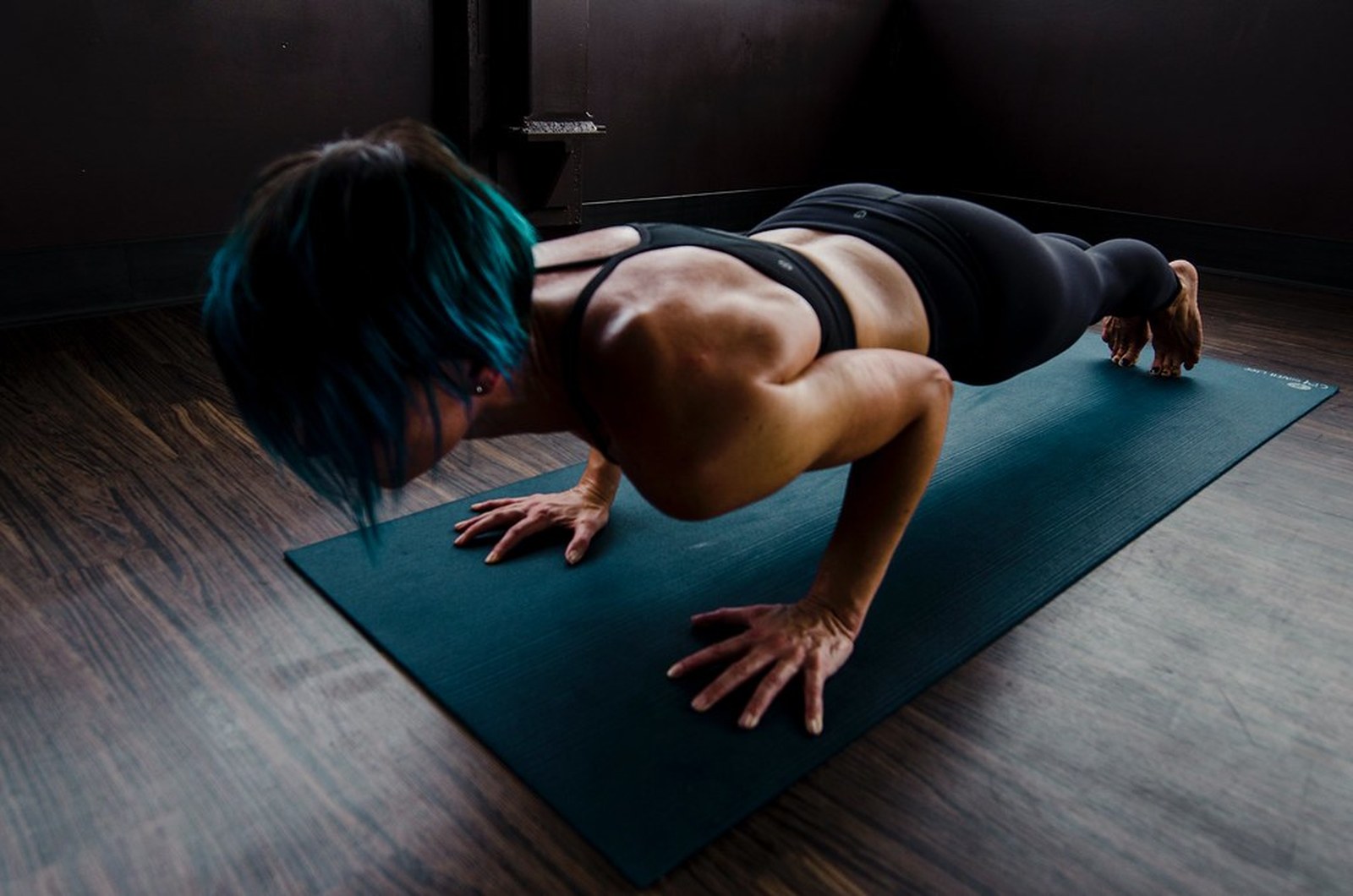
Featured image: a woman holding a push-up position on a mat. Photo by homegets.com on Flickr, CC BY 2.0: https://www.flickr.com/photos/141436406@N04/49778014313
FAQ
Is it safe to lift weights on my period?
For most people, yes. Strength training does not appear on any medical no-go list for menstruation. What changes is how much you can recover from, so save the one-rep-max attempts for a week when you feel less flat.
Should I skip the gym on my heaviest day?
Not automatically. If your flow is heavy and you feel drained, an easy session beats a hard one, but no medical rule says stay home. Adjust the plan instead of dropping the habit.
Does exercise make period pain worse?
The evidence points the other way. The 2024 network meta-analysis found exercise reduced pain intensity, and NHS lists gentle exercise among its self-care advice. If your experience differs, track it for two or three cycles before deciding.
Which exercises to avoid during your period should I genuinely skip?
Only the ones that make your symptoms worse on the day. The exercises to avoid during your period are the ones that spike pain, not a fixed list you have to memorise. Everything else stays optional.
Can too much exercise stop your period?
It can be one cause, and NHS lists it among the common reasons periods go missing. The mechanism is usually sustained low energy availability rather than the workout itself. If you have missed three periods in a row, see a GP.
Sources
- NHS. Period pain. https://www.nhs.uk/symptoms/period-pain/
- NHS. Heavy periods. https://www.nhs.uk/conditions/heavy-periods/
- NHS. Iron deficiency anaemia. https://www.nhs.uk/conditions/iron-deficiency-anaemia/
- NHS. Missed or late periods. https://www.nhs.uk/symptoms/missed-or-late-periods/
- Cleveland Clinic. Dysmenorrhea (menstrual cramps). https://my.clevelandclinic.org/health/diseases/4148-dysmenorrhea
- Li X, Hao X, Liu JH, Huang JP. Efficacy of non-pharmacological interventions for primary dysmenorrhoea: a systematic review and Bayesian network meta-analysis. BMJ Evid Based Med. 2024;29(3):162-170. https://pubmed.ncbi.nlm.nih.gov/38242565/
- Pedlar CR, Brugnara C, Bruinvels G, et al. Iron balance and iron supplementation for the female athlete: a practical approach. Eur J Sport Sci. 2018;18(2):295-305. https://pubmed.ncbi.nlm.nih.gov/29280410/
- Mayer C, Barker MK, Dirk P, et al. Menstrual blood losses and body mass index are associated with serum ferritin concentrations among female varsity athletes. Appl Physiol Nutr Metab. 2020;45(7):723-730. https://pubmed.ncbi.nlm.nih.gov/31869248/
- De Souza MJ, Koltun KJ, Williams NI. The role of energy availability in reproductive function in the Female Athlete Triad. Sports Med. 2019;49(Suppl 2):125-137. https://pubmed.ncbi.nlm.nih.gov/31696452/
- Ghazzawi HA, Khataybeh B, Al Aqaili R, et al. Protecting women’s health in sport: the role of low energy availability in the Female Athlete Triad and RED-S. Front Sports Act Living. 2026;8:1776533. https://pubmed.ncbi.nlm.nih.gov/42245081/