Most people who say they want to write things down are not actually looking for another blank page to feel guilty about. Two weeks of neat entries followed by four months of silence is the normal pattern, not a character flaw. A mood journal asks for something smaller: a number, a word, and one line about what happened. Keep it that short and it stops competing with the rest of your life.
Key takeaways
- A mood journal does not need paragraphs. A rating from 1 to 5 plus one specific line is enough.
- Research on writing about feelings is mixed. It is not a treatment and it is not a cure for a bad week.
- Tracking helps most when you are looking for patterns across weeks, not grading individual days.
- The habit that lasts is the one attached to something you already do, not one that needs a reminder.
- If low mood lasts for weeks and interferes with daily life, a notebook is not the answer. See a doctor.
Why most journaling advice falls apart
If you have ever bought a nice notebook and abandoned it in a drawer, the problem was probably the size of the ask rather than your discipline. Journaling advice usually arrives with a template: prompts, gratitude lists, reflection questions, a page minimum. Cleveland Clinic’s guide to coping with stress makes a point that applies here, that coping is a process rather than a single event, and that rigid strategies tend to serve people worse than flexible ones. A fixed template is rigid by design.
NHS guidance points in a different direction. Its stress-busting list does not ask for a page a day. It suggests writing down three things that went well, or that you are grateful for, at the end of every day, which works out to roughly ninety seconds. That is the size of habit worth building.
Two smaller practices from this blog pair well with tracking, and both are about lowering effort rather than raising it: the 4-7-8 breathing trick for the moment you need to come down, and letting go of the idea that self-care has to look impressive.
What a mood journal actually asks of you
A mood journal is a record, not a piece of writing. The version worth keeping has three parts: a number for how you feel, one line about what happened, and the date. There are no prompts to answer and no paragraphs to produce.
In a mood journal, the number matters more than the words. Rating your mood from 1 to 5 takes a second, and unlike prose it can be compared across months. The word “fine” tells you nothing in November about what October felt like; a 2 tells you something immediately.
One line of context makes the number useful later. A note like “3, slept badly, big meeting” takes ten seconds and explains a dip you would otherwise misread as a bad month. Skip the line and you are left with a chart and no story. If you would rather write at length than rate, our guide to a journaling method that survives covers that; a mood journal is the smaller cousin.
What the research says about tracking how you feel
A 2026 systematic review and meta-analysis in JMIR Mental Health pooled 8 randomized trials with 1,230 participants and six different mood monitoring protocols. In people with bipolar disorder it found a small effect on mania symptoms that was not statistically significant (n=873, P=.06) and no effect on bipolar depression. In people with depression it found a small effect of borderline significance at 12 months (2 comparisons, n=262, SMD -0.25, P=.05) but not at 6 months. The authors found no evidence that mood monitoring changed relapse or readmission rates.
The honest reading is that tracking how you feel is not a treatment and does not reliably lift symptoms on its own. What it can do is hand you information. That is a modest claim, and it is the one the evidence supports.
Research on writing itself is similarly cautious. A meta-analysis of 16 randomized trials of expressive writing in cancer patients and survivors found no statistically significant benefit for psychological outcomes (Hedges g 0.04), physical outcomes (0.08) or quality of life (0.09). A separate meta-analysis of 8 trials with 929 women found expressive writing reduced PTSD symptoms related to pregnancy but made no measurable difference to anxiety or stress, and the depression result was inconclusive.
So why does naming a feeling seem to help at all? One line of research on affect labeling, the plain act of putting feelings into words, found that brain activity during that act predicted changes in depression, anxiety and life satisfaction three months later. That is a mechanism, not a promise, and it suggests the value sits in the naming. Which is why a mood journal does not need to be long.
Adherence is where most tracking quietly dies. A 2026 review of 77 mood tracking and ambulatory assessment studies with 17,123 participants reported a pooled adherence proportion of 0.64 and attrition of 0.28, with very high heterogeneity between studies. The detail worth knowing is that mood monitoring reminders were associated with lower adherence, not higher. A mood journal that nags you is one you will eventually avoid.
A two-minute mood journal setup
A mood journal that survives is boring to look at and takes under a minute. Pick one place you already look at daily, and put the entry there. A notes app on the phone you already carry works better than a notebook that lives in a drawer.
- Date and a number from 1 to 5, written the same way every time.
- One line of what happened, kept under ten words.
- Anything obvious that could explain it: sleep, alcohol, your period, a deadline.
- A single word for the dominant feeling, which is the part affect labeling research cares about.
Then leave it alone until tomorrow. Reading yesterday’s entry is fine; scoring your week is not. The moment a mood journal becomes a report card, you will start writing what you want to see.
Review it once a month, not once a day. Lay the month out and look for repeats: the same weekday dip, the same few days before your period, the same reaction to a particular meeting. NHS guidance on mindfulness makes a related point, that noticing signs of stress earlier gives you a better chance of dealing with them. There are more ideas like this in our self-care archive.
When a mood journal is not the answer
A mood journal is a good tool for spotting patterns and a poor tool for treating anything. Depression, as NHS describes it, is a low mood that lasts for weeks or months and affects daily life. If that sounds familiar, a notebook will not fix it. Talk to a doctor or a mental health professional.
There are also signs that need attention sooner than a monthly review allows. Watch for low mood that has not lifted in several weeks, losing interest in things you used to enjoy, persistent changes in sleep or appetite, or drinking more to cope. If you have thoughts of harming yourself, contact emergency services or a crisis line in your country straight away, and do not wait for a pattern to emerge.
How Ananta can help
Ananta is our own app, and mood tracking is one of the things it does. A mood tracker records your daily mood and shows it as a monthly graph, which is the pattern view a paper log only gives you if you do the arithmetic yourself. It also includes guided journaling prompts, daily affirmations, a sleep log and a water reminder, so the entry you write can sit next to the sleep and hydration data that often explains it. You can get it free on Google Play and see it alongside the rest of our apps on the products page.
FAQ
Does a mood journal have to be written every day?
No. Missing days is normal, and a gap is data too. What matters is that each mood journal entry is short enough that you come back instead of quitting.
What should I actually write in a mood journal?
Three things: a number, one line of context, and a word for the feeling. That is enough to compare one month with another. If you feel like writing more on some days, treat it as a bonus rather than a requirement.
Is a mood journal the same as therapy?
No. It is a record that can help you and your doctor spot patterns. Writing does not treat depression or anxiety on its own, and the research on written disclosure is mixed.
Can tracking my mood make me feel worse?
Possibly, if you use it to grade yourself. The evidence on mood monitoring in bipolar disorder found no overall increase in symptoms, and reminders were linked to lower adherence rather than better results. Keep your mood journal entries short and the review monthly.
Is paper or an app better for a mood journal?
Whichever one you will actually open. Paper is private and has no battery to run out; an app can draw the month for you and sit next to your sleep and water data. The format matters far less than the size of the daily entry.
This article is educational and is not medical advice. It does not replace care from a qualified healthcare professional. If your mood is affecting your daily life, please talk to a doctor.
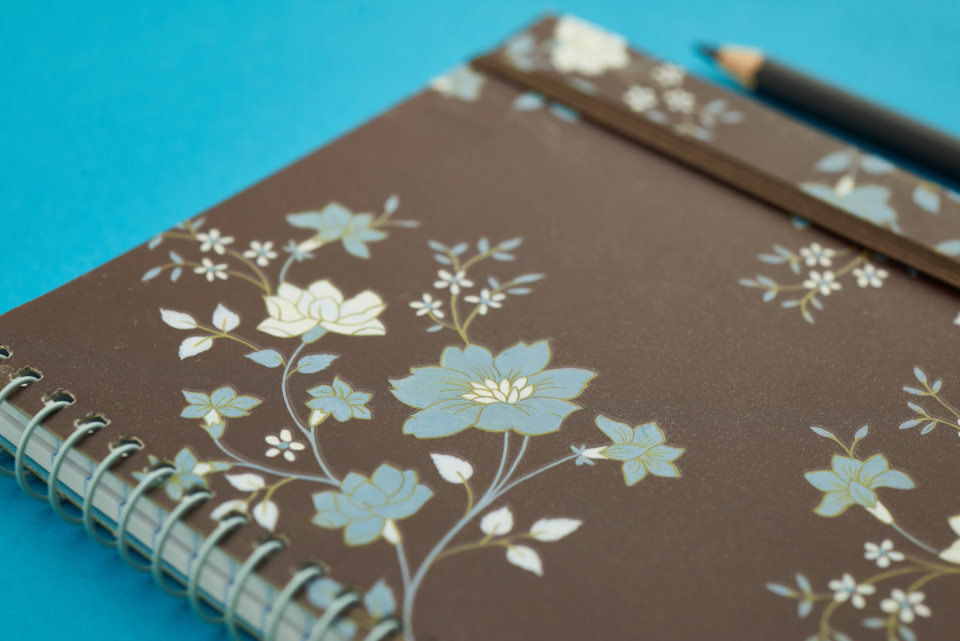
Featured image: “Journal Notepad” by Artsy Crafty via StockSnap, CC0 1.0.
Sources
- NHS. 10 stress busters. https://www.nhs.uk/mental-health/self-help/guides-tools-and-activities/tips-to-reduce-stress/
- NHS. Mindfulness. https://www.nhs.uk/mental-health/self-help/tips-and-support/mindfulness/
- NHS. 5 steps to mental wellbeing. https://www.nhs.uk/mental-health/self-help/guides-tools-and-activities/five-steps-to-mental-wellbeing/
- NHS. Depression in adults. https://www.nhs.uk/mental-health/conditions/depression-in-adults/
- Cleveland Clinic. Stress: Coping With Life’s Stressors. https://my.clevelandclinic.org/health/articles/6392-stress-coping-with-lifes-stressors
- Astill Wright L, Shajan G, Purewal D, et al. Mood Monitoring, Mood Tracking, and Ambulatory Assessment Interventions in Depression and Bipolar Disorder: Systematic Review and Meta-Analysis of Randomized Controlled Trials. JMIR Mental Health. 2026. https://pubmed.ncbi.nlm.nih.gov/41499681/
- Astill Wright L, Roe J, Guo B, Morriss R. Dropout, Attrition, Adherence, and Compliance in Mood Monitoring and Ambulatory Assessment Studies for Depression and Bipolar Disorder: Systematic Review and Meta-Analysis. JMIR Mental Health. 2026. https://pubmed.ncbi.nlm.nih.gov/41525703/
- Zachariae R, O’Toole MS. The effect of expressive writing intervention on psychological and physical health outcomes in cancer patients: a systematic review and meta-analysis. Psycho-Oncology. 2015. https://pubmed.ncbi.nlm.nih.gov/25871981/
- Memarian N, Torre JB, Haltom KE, Stanton AL. Neural activity during affect labeling predicts expressive writing effects on well-being: GLM and SVM approaches. Social Cognitive and Affective Neuroscience. 2017. https://pubmed.ncbi.nlm.nih.gov/28992270/
- Qian J, Zhou X, Sun X, Wu M. Effects of expressive writing intervention for women’s PTSD, depression, anxiety and stress related to pregnancy: a meta-analysis of randomized controlled trials. Psychiatry Research. 2020. https://pubmed.ncbi.nlm.nih.gov/32315889/


.jpg)