That kind of pain does not care about your plans. By the time the painkillers wear off, most people will try whatever is in the cupboard. So does magnesium for period cramps actually change anything, or is it a supplement with a better marketing budget than evidence? The research is small, older than you would expect, and more interesting than the internet usually admits.
Key takeaways
- Magnesium sits in more than 300 enzyme reactions, including the muscle and nerve functions that decide how a contraction feels.
- The strongest evidence for painful periods comes from three small trials published in 1989 and 1990, plus one 2022 trial against the contraceptive pill.
- A 2016 Cochrane review of 27 supplement trials rated every comparison low or very low quality, and safety reporting was close to absent.
- The upper limit for magnesium from supplements is 350 mg a day, and diarrhoea is the usual sign you have passed it.
- Food carries magnesium with no laxative ceiling, and pumpkin seeds, beans, nuts and leafy greens are the cheapest places to find it.
What magnesium does in your body
Magnesium is a mineral your body uses in more than 300 enzyme reactions: building proteins and bones, regulating blood sugar and blood pressure, and running muscle and nerve signals. Harvard’s Nutrition Source describes it as an electrical conductor that contracts muscles and keeps the heart beating steadily.
Muscle contraction is the part that matters for monthly pain. Period pain happens when the womb tightens during your period, according to the NHS. A 2020 review in Nutrients explains magnesium’s role in pain as an antagonist at the NMDA receptor, which reduces central sensitisation and dampens an already sensitised pain system.
Nobody has shown that low magnesium causes period pain. The mineral simply sits inside the pathways that regulate contraction and pain signalling, which is why researchers tested whether adding more of it changes the experience.
What the evidence on magnesium for period cramps shows
The best summary of magnesium for period cramps is still the 2001 Cochrane review by Proctor and Murphy. Three small trials compared magnesium with placebo, and overall magnesium was better for pain relief while women needed less additional medication. There was no significant difference in the number of adverse effects. The reviewers called magnesium promising, but said the dose and schedule could not be pinned down from the trials available.
Two of those trials are worth knowing in detail. Seifert and colleagues followed 50 women with primary dysmenorrhoea for six months in a double-blind study: 21 of the 25 women on magnesium reported fewer symptoms, and prostaglandin F2 alpha in menstrual blood fell to 45% of the pre-treatment level, against 90% in the placebo group. Fontana-Klaiber and Hogg ran a smaller double-blind trial of 32 women and analysed 21 of them. Magnesium did little on day one, helped back pain and lower abdominal pain on days two and three, and cut days lost from work.
Newer evidence is thinner than the supplement aisle suggests. A 2022 study followed 172 women with primary dysmenorrhoea for three cycles: 86 took 200 mg of magnesium citrate daily and 86 took a combined oral contraceptive. The magnesium group finished with significantly lower pain scores than before treatment and needed fewer painkillers, but the contraceptive group did better on both measures. That study had no placebo arm.
A 2020 meta-analysis of micronutrients in primary dysmenorrhoea screened 16 clinical trials and listed magnesium among the supplements with a desirable effect on pain. Only six studies were pooled, though, and the pooled results that reached significance were for vitamin D and vitamin E, not magnesium.
The honest counterweight for anyone weighing magnesium for period cramps is the 2016 Cochrane review of dietary supplements for period pain. It covered 27 trials and 3,101 women, mostly students in their late teens and early twenties in Iran, and graded every comparison as low or very low quality. Only four of the 27 trials reported adverse effects in both treatment groups. Magnesium was not among the supplements included in that update, so the 2001 conclusion remains the fairest reading: promising, tiny, and unclear on dose.
One more finding is worth flagging for anyone whose symptoms run into the week before their period. A 2017 systematic review of 14 trials found that magnesium combined with vitamin B6 reduced premenstrual anxiety, but magnesium on its own did not, and neither version changed stress levels in women with dysmenorrhoea.
Which type of magnesium, and how much
Supplements come as magnesium oxide, hydroxide, gluconate, chloride and citrate salts, plus amino acid chelates such as magnesium aspartate. A few of those salts are also used as antacids and laxatives, which tells you something about how they behave in the gut. No trial has compared the forms head to head for cramps, and the studies that did show a benefit used different preparations: a granulate in 1990, 200 mg of citrate daily in 2022. The practical answer for magnesium for period cramps is to pick a form you tolerate and can take consistently.
The dose ceiling is better documented than the dose target. The tolerable upper intake level for magnesium is 350 mg a day from supplements only, and it exists specifically because higher intakes cause diarrhoea and gastrointestinal upset. That limit does not apply to magnesium from food, because the kidneys clear the excess.
Magnesium also interferes with some medicines. It reduces the absorption of digoxin, nitrofurantoin and certain antimalarials, needs a two-hour gap from bisphosphonates such as alendronate, and can reduce the effect of chlorpromazine, penicillamine, oral anticoagulants and quinolone antibiotics. If you take prescription medicine daily, ask a pharmacist before adding a supplement.
Food sources first
About 30% to 40% of the magnesium you eat is absorbed, and absorption shifts with the amount eaten and with the rest of the meal. Adults need 310 to 320 mg a day, more during pregnancy. Good sources, according to MedlinePlus and Harvard, include:
- Pumpkin seeds, almonds, cashews, peanuts and hazelnuts.
- Beans, peas, lentils, chickpeas and soy products such as tofu.
- Leafy greens such as spinach, whole grains such as brown rice, avocados and bananas.
- Milk, and fortified foods such as breakfast cereals.
A bowl of beans and a handful of seeds gets you a long way toward the daily figure without touching the supplement ceiling. If your diet is already built on those foods, the case for a pill gets weaker.
What else helps with cramps
The NHS self-care list is unglamorous and better evidenced than any supplement: a warm bath or shower, a heat pad or hot water bottle wrapped in a tea towel on your tummy, massage, and gentle exercise such as yoga, swimming, walking or cycling. Paracetamol and ibuprofen are listed as first-line painkillers, and ibuprofen specifically lowers the prostaglandins behind the contractions.
Three articles on this site go deeper on those options. Our piece on heat for period cramps covers the head-to-head trials, ginger and chamomile tea looks at the herbal evidence and its limits, and what to eat on your period maps food to each phase of the cycle. For more in this cluster, browse the Cycle & Fertility archive.
When to talk to a doctor
Period pain that is severe or worse than usual and has not eased with painkillers needs an urgent appointment or a call to NHS 111. Book a routine appointment if your periods are getting heavier or more painful, if pain stops you doing your usual activities, if sex or going to the toilet hurts, if you bleed between periods, or if you have a swollen tummy, no appetite or unexplained weight loss. Skip magnesium supplements until you have spoken to a doctor if you have kidney problems, because impaired kidney function raises the risk of a build-up.
How Lail can help
Lail is our own period tracker for Android, and it keeps everything on your phone rather than in a cloud account. You can log symptoms, mood, flow and weight, and see insights built around each phase of your cycle, which is how you find out whether the magnesium, the heat pad or the earlier bedtime actually changed anything. There is no account and no cloud backup; the database is encrypted on your device. You can download Lail from the Play Store or find it alongside our other apps on the products page.
How long does magnesium take to work for period cramps?
The trials that showed a benefit dosed across whole cycles rather than single days. The 1990 study gave magnesium the day before bleeding plus days one and two, while the 2022 study measured pain after three cycles. Give magnesium for period cramps two full cycles before you judge it.
Which magnesium is best for period cramps?
No trial has compared the forms against each other for cramps, so any confident ranking online is guesswork. Trials have used a granulate and magnesium citrate, and the safety limit of 350 mg a day applies to all of them. Choose one you tolerate and keep the total below that ceiling.
Should I take magnesium every day or only during my period?
Both approaches have been tested, and neither has been compared with the other. The 1989 trial dosed continuously for six months, while the 1990 trial used a short window around bleeding. Daily dosing is easier to remember; the trade-off is more days of loose stools if you overshoot the dose.
Can magnesium replace painkillers?
No. In the 2022 trial the contraceptive pill outperformed magnesium, and the NHS still lists paracetamol and ibuprofen as first-line treatment. Treat magnesium as an addition to your usual pain plan, not a replacement for it.
This article is educational and is not medical advice. Talk to a qualified healthcare provider about your own symptoms, medicines and supplements.
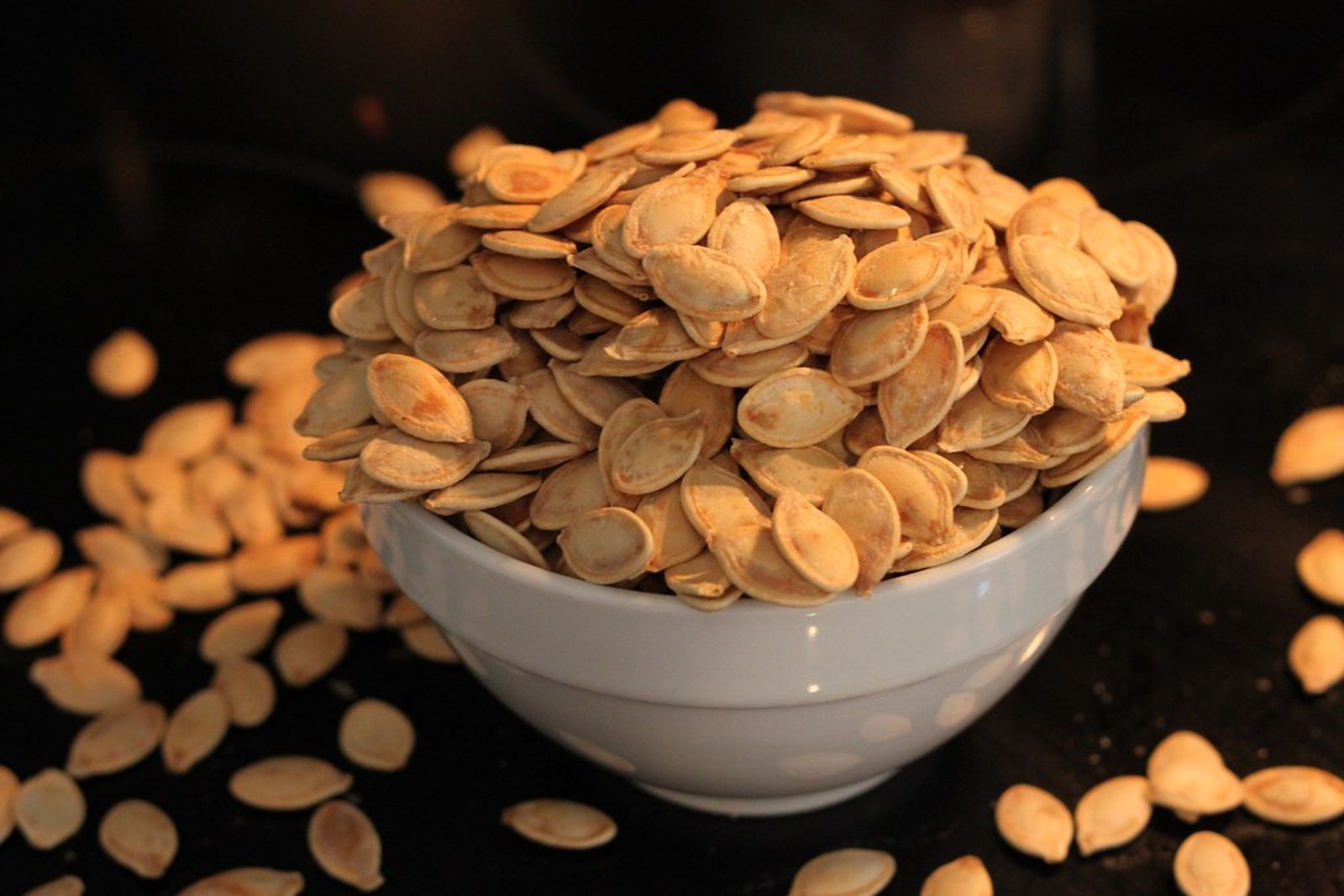
Featured image: Roasted Pumpkin Seeds by jaxzin via Flickr (CC BY 2.0).
Sources
- NHS. Period pain. https://www.nhs.uk/symptoms/period-pain/
- Linus Pauling Institute, Oregon State University. Magnesium. https://lpi.oregonstate.edu/mic/minerals/magnesium
- Harvard T.H. Chan School of Public Health, The Nutrition Source. Magnesium. https://nutritionsource.hsph.harvard.edu/magnesium/
- MedlinePlus. Magnesium in diet. https://medlineplus.gov/ency/article/002423.htm
- Proctor ML, Murphy PA. Herbal and dietary therapies for primary and secondary dysmenorrhoea. Cochrane Database Syst Rev. 2001;(3):CD002124. https://pubmed.ncbi.nlm.nih.gov/11687013/
- Pattanittum P, Kunyanone N, Brown J, et al. Dietary supplements for dysmenorrhoea. Cochrane Database Syst Rev. 2016;3(3):CD002124. https://pubmed.ncbi.nlm.nih.gov/27000311/
- Seifert B, Wagler P, Dartsch S, et al. Magnesium, a new therapeutic alternative in primary dysmenorrhea. Zentralbl Gynakol. 1989;111(11):755-760. https://pubmed.ncbi.nlm.nih.gov/2675496/
- Fontana-Klaiber H, Hogg B. Therapeutic effects of magnesium in dysmenorrhea. Schweiz Rundsch Med Prax. 1990;79(16):491-494. https://pubmed.ncbi.nlm.nih.gov/2349410/
- Gok S, Gok B. Investigation of laboratory and clinical features of primary dysmenorrhea: comparison of magnesium and oral contraceptives in treatment. Cureus. 2022;14(11):e32028. https://pubmed.ncbi.nlm.nih.gov/36600872/
- Saei Ghare Naz M, Kiani Z, Rashidi Fakari F, et al. The effect of micronutrients on pain management of primary dysmenorrhea: a systematic review and meta-analysis. J Caring Sci. 2020;9(1):47-56. https://pubmed.ncbi.nlm.nih.gov/32296659/
- Shin HJ, Na HS, Do SH. Magnesium and pain. Nutrients. 2020;12(8):2184. https://pubmed.ncbi.nlm.nih.gov/32718032/
- McCabe D, Lisy K, Lockwood C, et al. The impact of essential fatty acid, B vitamins, vitamin C, magnesium and zinc supplementation on stress levels in women: a systematic review. JBI Database System Rev Implement Rep. 2017;15(2):402-453. https://pubmed.ncbi.nlm.nih.gov/28178022/