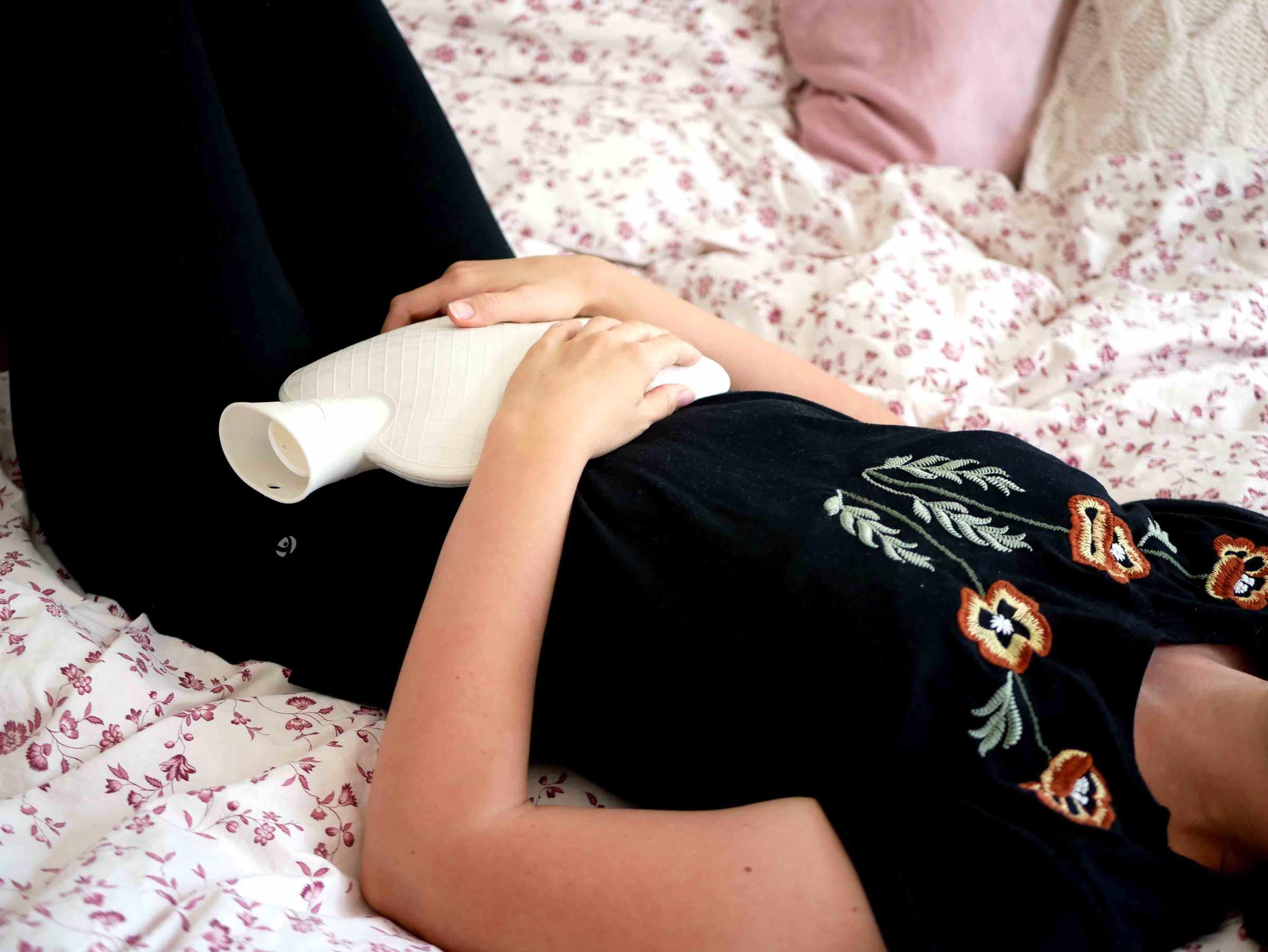
The first day of bleeding is usually the hardest, when contractions in the uterus are strongest and no position on the sofa feels quite right. The ache can last up to three days, and it often spreads into your back and thighs. If you have ever wondered why heat for period cramps works so well, the answer comes down to two things: what warmth does to a muscle that will not loosen, and what the clinical trials actually measured. Both point the same way, though the research is quieter than the labels on heat patches suggest.
Key takeaways
- Heat for period cramps has been tested head to head against painkillers in three separate trials, and it held its own.
- A 2024 network meta-analysis of 33 trials put topical heat among the non-drug options that reduce menstrual pain.
- The trials used continuous low-level heat patches at around 40°C for 8 to 12 hours a day, longer than most people use a hot water bottle.
- Cramps come from prostaglandins, the chemicals that make the uterus contract, and warmth relaxes muscle and increases blood flow.
- Heat eases pain but does not treat endometriosis, fibroids or an infection, so pain that keeps getting worse needs a doctor.
Why warmth helps a cramping uterus
Menstrual cramps start with a chemical called prostaglandin. Levels rise just before bleeding begins, which makes the uterus contract harder to shed its lining. Those contractions are the ache you feel, and they explain why day one and day two usually hurt most.
Warmth does not switch prostaglandins off. What it does is act on the muscle and the tissue around it. Superficial heat relaxes tight muscle, widens blood vessels and increases blood flow to the area, which is the closest thing to a direct answer to why heat for period cramps keeps showing up in self-care advice.
A randomised trial of 371 people with acute low back pain is the cleanest demonstration of that muscle effect. An 8-hour heat wrap held at 40°C reduced muscle stiffness more than acetaminophen did, and improved how far participants could bend sideways. Period cramps are not back pain, but the response of a tense muscle to steady warmth is the same.
What the trials on heat for period cramps found
The strongest summary comes from a 2024 Bayesian network meta-analysis in BMJ Evidence-Based Medicine. It pooled 33 randomised trials and eight non-drug interventions, from exercise to acupuncture. Topical heat cut pain on a 10-point visual analogue scale by 2.97 points (95% CI -4.66 to -1.29), which placed it in the same range as exercise at -3.20 and acupuncture at -2.90.
The authors stayed careful. Their conclusion was that non-drug options “may result in a reduction or slight reduction in pain intensity”, and they called for larger, better-designed trials. Treat that as good news with an asterisk, not a cure.
The head-to-head comparisons are more interesting. A 2001 study in Obstetrics & Gynecology gave 84 women either a heated patch or an unheated one, plus either ibuprofen 400 mg three times a day or a placebo. Over two days, the heated patch with placebo scored 3.27 for pain relief, ibuprofen scored 3.07, and the unheated patch with placebo scored 1.95. Heat on its own matched ibuprofen, and when the two were combined, noticeable relief arrived in a median 1.5 hours instead of 2.79.
Three years later the same research group compared a heat wrap with acetaminophen 1000 mg in 344 women. The heat wrap came out ahead for pain relief over eight hours, at 2.48 against 2.17, and for abdominal tightness. It also reported less fatigue and fewer mood swings.
A 2012 trial in BMC Women’s Health took a different route. It gave 147 students either an iron-chip heat patch or ibuprofen, and the patch performed about as well as the drug at most time points, with differences that did not reach statistical significance. The caveat across all of this is size. A 2016 Cochrane review of 27 trials covering 3,101 women rated the wider evidence for period-pain remedies as low or very low quality, which shows how thin the base underneath these numbers still is.
Which kind of heat to reach for
- A heat pad or hot water bottle on the tummy, wrapped in a tea towel, is what the NHS recommends and the cheapest option.
- Adhesive heat patches sit under clothing and give steady low-level warmth for hours, which is why the trials used them.
- A warm bath or shower covers the whole lower half of the body and fits easily into the end of a day.
- Microwaveable wheat bags do the same job as a hot water bottle, with the same burn risk if they come out too hot.
How to use heat without burning yourself
Heat is low risk, but contact burns from pads and bottles are common enough that the NHS says to wrap a hot water bottle in a tea towel rather than resting it against bare skin. Check your skin every 20 minutes or so, and move the heat source if the area is turning deep red. Do not fall asleep with an electric pad switched on, because contact burns build up while you are unaware of them, and the same applies to heat patches left on overnight. If your skin is numb, or you have diabetes or nerve damage that dulls sensation, ask a clinician before using a heating pad, since you may not feel a burn starting.
If you might be pregnant, ask a midwife or doctor before applying heat to your abdomen. Heat also runs alongside painkillers rather than replacing them, and ibuprofen is the one that lowers prostaglandin production. Just do not stack a heat patch and a hot water bottle on the same spot at the same time.
When to see a doctor
Period pain is normal. Pain that stops you living normally is not. Ask for an urgent appointment if your pain is severe, or worse than usual, and painkillers have not touched it.
Book a routine appointment if your periods are getting more painful, heavier or irregular, if the pain stops you working or studying, or if you bleed between periods. Pain during sex, or when you pee or poo, also needs a doctor rather than another heat pack. Endometriosis, adenomyosis, fibroids and pelvic inflammatory disease all cause painful periods, and all of them need treatment.
An IUD can cause cramps for the first three to six months after fitting, which is worth knowing before you blame your cycle. If heat and ibuprofen are not enough month after month, ask about prescription options such as naproxen, mefenamic acid, hormonal contraception, a TENS machine or a referral to a gynaecologist.
How Lail can help
Lail is a private period tracker for Android that keeps your cycle, symptoms, mood and weight on your own device, with no account and no cloud backups. Seeing which days you usually cramp means you can have the heat pad ready before the pain peaks, and its insights suggest foods for the phase you are in. Lail is free with ads, and a premium tier of around Rp10,000 a month adds PDF export. You can also get it on Google Play.
FAQ
How long can you leave a heating pad on your stomach?
There is no research-backed time limit, because the trials used steady low-level patches for 8 to 12 hours a day rather than a hot water bottle. A workable routine is to keep heat on while it is helping and to check your skin every 20 minutes. Take a break once the pain eases instead of leaving it on all evening.
Does heat work as well as ibuprofen for period cramps?
In one trial on heat for period cramps, a heated patch relieved pain about as well as ibuprofen 400 mg taken three times a day, and the two together brought relief faster than ibuprofen alone. A second trial found a heat wrap beat acetaminophen over eight hours. These were single studies of a few hundred women, so read the comparison as encouraging rather than settled.
Heat or ice for period pain?
Warmth is what the trials and NHS self-care advice support, and every study behind these numbers used heat on the abdomen. Cold belongs to swelling and injury rather than cramps. If cold makes your belly feel worse, that is worth listening to.
Is it safe to sleep with a heating pad or heat patch on?
Not with an electric pad left running, and not with a patch pressed against skin for a whole night. Contact burns develop while you sleep, which is exactly why the NHS says to wrap a hot water bottle in a towel. Use heat while you are awake, then put it aside before you drift off.
This article is educational and is not medical advice. Talk to a doctor or pharmacist about your own symptoms, and check with them before combining heat with any medication.
Featured image: “Experiencing menstrual pain with hot water bottle” by Vulvani, CC BY-SA 4.0, via Wikimedia Commons.
Sources
- NHS. Period pain. https://www.nhs.uk/symptoms/period-pain/
- Cleveland Clinic. Dysmenorrhea (Painful Periods). https://my.clevelandclinic.org/health/diseases/4148-dysmenorrhea
- Li X, Hao X, Liu JH, Huang JP. Efficacy of non-pharmacological interventions for primary dysmenorrhoea: a systematic review and Bayesian network meta-analysis. BMJ Evidence-Based Medicine. 2024. https://pubmed.ncbi.nlm.nih.gov/38242565/
- Akin MD, Weingand KW, Hengehold DA, et al. Continuous low-level topical heat in the treatment of dysmenorrhea. Obstetrics & Gynecology. 2001. https://pubmed.ncbi.nlm.nih.gov/11239634/
- Akin M, Price W, Rodriguez G Jr, et al. Continuous, low-level, topical heat wrap therapy as compared to acetaminophen for primary dysmenorrhea. Journal of Reproductive Medicine. 2004. https://pubmed.ncbi.nlm.nih.gov/15493566/
- Navvabi Rigi S, Kermansaravi F, Navidian A, et al. Comparing the analgesic effect of heat patch containing iron chip and ibuprofen for primary dysmenorrhea: a randomized controlled trial. BMC Women’s Health. 2012. https://pubmed.ncbi.nlm.nih.gov/22913409/
- Nadler SF, Steiner DJ, Erasala GN, et al. Continuous low-level heat wrap therapy provides more efficacy than ibuprofen and acetaminophen for acute low back pain. Spine. 2002. https://pubmed.ncbi.nlm.nih.gov/12004166/
- Pattanittum P, Kunyanone N, Brown J, et al. Dietary supplements for dysmenorrhoea. Cochrane Database of Systematic Reviews. 2016. https://pubmed.ncbi.nlm.nih.gov/27000311/
Leave a Reply