Nobody sets out to believe something that is not true. The beliefs arrive sideways: a remark in a changing room, a warning from an older relative, a leaflet somebody half-read at school. That is how most period myths survive, because they sound careful or protective, so nobody goes back and checks them. Here is what the evidence says about six of them, including two doctors would rather people stopped repeating.
Key takeaways
- Period myths tend to sound protective, which is why they outlive the facts.
- You lose about 20 to 90ml of blood across a whole period, roughly 1 to 5 tablespoons.
- A tampon cannot get lost inside you, and tampons are not a reason to panic about toxic shock either.
- Cycle syncing is disputed: one 2023 study found it, two measurement reviews argue the finding is an artefact.
- PMS is real and common, while the supplements sold for it have thin evidence.
“You can’t get pregnant on your period”
Fertility is set by ovulation, not by bleeding, and ovulation happens about 12 to 16 days before the next period starts. The period myths here treat the days you bleed as the risky days and the dry ones as free, when the fertile window actually sits mid-cycle. Sperm can survive in the fallopian tubes for up to 7 days after sex, according to NHS, and an egg lives about 12 to 24 hours after it is released.
That timing is why a short cycle can put ovulation close enough to the end of bleeding that period sex is not automatically safe. NHS states it plainly: getting pregnant soon after a period finishes is possible, though not very likely, if you ovulate early or your cycles are short. Sources disagree on sperm survival, with NHS saying up to 7 days and Cleveland Clinic saying 3 to 5 days, so treat 3 to 5 days as typical and 7 days as the outer edge.
The blood loss is smaller than it looks
Blood loss is one of the easier period myths to check, because it comes with a number. NHS puts total loss at about 20 to 90ml, which is 1 to 5 tablespoons, and notes that some people bleed more than that, in which case heavy periods are treatable. What leaves the body is blood plus the womb lining that thickened during the cycle.
Colour is a poor gauge of anything. NHS describes the heaviest days as red and lighter days as pink or brown, a normal range rather than a warning. If you are soaking through protection every hour or passing coin-sized clots, that is the point to book an appointment instead of buying a heavier pad, and our guide to period blood clots covers what the size means.
A tampon cannot get lost inside you
NHS is unusually blunt here: it is not possible for a tampon to get lost inside you, because the vagina holds it firmly in place and the tampon expands as it soaks up blood. The vagina is a closed space, so there is nowhere for it to travel. Tampons attract a stubborn set of period myths, and this is the one that sends people to a clinic in a state.
If the string has gone missing and you cannot reach the tampon, a clinician can remove it. Leaving one in for days is a real toxic shock risk, so it is worth being seen rather than waiting it out.
Tampons, toxic shock and the eight-hour rule
Toxic shock is rare, serious, and not only about tampons, which is where several period myths get tangled together. NHS describes it as a rare but life-threatening infection that can follow a tampon or menstrual cup, an infected wound or burn, a diaphragm or cap, or a vaginal birth. Symptoms arrive quickly, and the ones to know are a high temperature, muscle aches, flu-like feelings and a rash that feels rough like sandpaper.
Cleveland Clinic turns prevention into something usable: change a tampon every 4 to 8 hours, choose the lowest absorbency that works, wear pads overnight, and skip tampons when you are not bleeding. It also notes there is no exact safe time, only a growing risk the longer one stays in.
How rare is rare? A French study of intensive care admissions over 15 years found 102 patients with menstrual toxic shock across 43 units, at a median age of 18. Most needed drugs to support their blood pressure and 21% were put on a breathing tube, and none died in intensive care.
A 2020 review in Clinical Microbiology Reviews adds that cases have not gone away, and that toxin-producing strains appear to be re-emerging. The practical lesson is the 8-hour clock.
Do periods really sync up?
Most period myths get settled by evidence, and this one has not been. A 2023 study followed 62 medical students living two to a room for 13 months and found the gap between their period onsets narrowing, with synchrony in about 55% of pairs and asynchrony in 26%. That is a real finding from a real study, and a small one, with 31 pairs and no control group.
The counterweight comes from two measurement reviews by Jeffrey Schank. His argument is that the standard calculation of onset differences is biased towards detecting synchrony when cycles vary in length, so a positive result can be an artefact of the arithmetic rather than the biology. His 2000 paper is blunt: synchrony is close to impossible when there is cycle variability, so finding it may point to flawed measurement rather than a phenomenon.
What both camps agree on is the part period myths skip: nothing here says a shared cycle is something you can plan around. Cycle syncing stays a fair question, and the confident answers on both sides are the problem.
PMS is not in your head
PMS is a physical and emotional pattern with a timetable, and treating it as a mood problem is where people get stuck. NHS says most women get it at some point, that it can affect anyone who has periods, and that symptoms usually lift once bleeding starts. Cleveland Clinic puts numbers on it: almost 50% of people who menstruate report at least one PMS symptom, and about 20% of that group have symptoms severe enough to disrupt daily life.
Treatment is where this batch of period myths does damage, because the supplement shelf is louder than the evidence. NHS lists vitamin B6, calcium, vitamin D and magnesium among things that may help, then says there is not much evidence that they work. What has a GP behind it is different: exercise, sleep, smaller meals, painkillers, and where symptoms interfere with life, hormonal treatment, CBT or antidepressants. If PMS is the specific thing you are trying to manage, PMS relief that works goes through those options one by one and marks which have trial evidence behind them.
Why period myths survive
Period myths rarely arrive with a source. Most of them started as protection: warn a teenager off tampons and you might spare her one bad habit along with all the swimming. Say nothing about cycles and the gap fills with folklore anyway, from adverts, group chats and old jokes. We have checked a few on their own, including daily panty liners, soda and exercise, while the rest sit in the Cycle & Fertility archive.
A cheap test for any claim about your body is whether it arrives with a mechanism and a number, or only with a warning. Blood loss has a number, 20 to 90ml. Toxic shock has a timing rule, 4 to 8 hours. Cycle syncing has neither.
When to get medical help
- Severe pelvic pain that painkillers do not touch needs an urgent GP appointment or NHS 111.
- See a GP if your periods become heavier, more painful or irregular, if pain stops you doing daily activities, or if you bleed between periods.
- For toxic shock symptoms such as a high temperature with muscle aches, vomiting, diarrhoea or a sandpaper rash, call NHS 111 and remove any tampon or menstrual cup; call 999 for confusion, breathing difficulty or peeling skin.
- For PMS, see a GP if lifestyle changes have not helped or your symptoms are affecting daily life.
How Lail can help
Lail is our own period tracker for Android, built to keep cycle data on your phone rather than in an account. It logs flow, symptoms, mood and weight, which is the two-cycle record NHS asks for at a PMS appointment. You can install it from Google Play, and the other apps we make are listed on our products page.
FAQ
How much blood do you actually lose on your period?
About 20 to 90ml across the whole period, which is 1 to 5 tablespoons. Bleeding more than that is common and treatable. Soaking protection every hour or passing coin-sized clots needs a GP appointment.
Can a tampon stay in overnight?
Cleveland Clinic advises pads at night, since the risk grows after 8 hours. If you sleep in a tampon, use the lowest absorbency that works and remove it first thing.
Is cycle syncing real?
Partly, and less often than the internet suggests. The 2023 study on roommates found it, while the measurement reviews say such findings can come from biased arithmetic. Neither camp says you can plan around a shared cycle.
Do I need to track my cycle if it is regular?
Regular does not mean uninformative. A record shows what is normal for you, which is the only baseline that makes a change visible. It is also the record a GP will ask for if something shifts.
This article is educational and is not medical advice. See a qualified healthcare provider about your own symptoms, and do not delay urgent care.
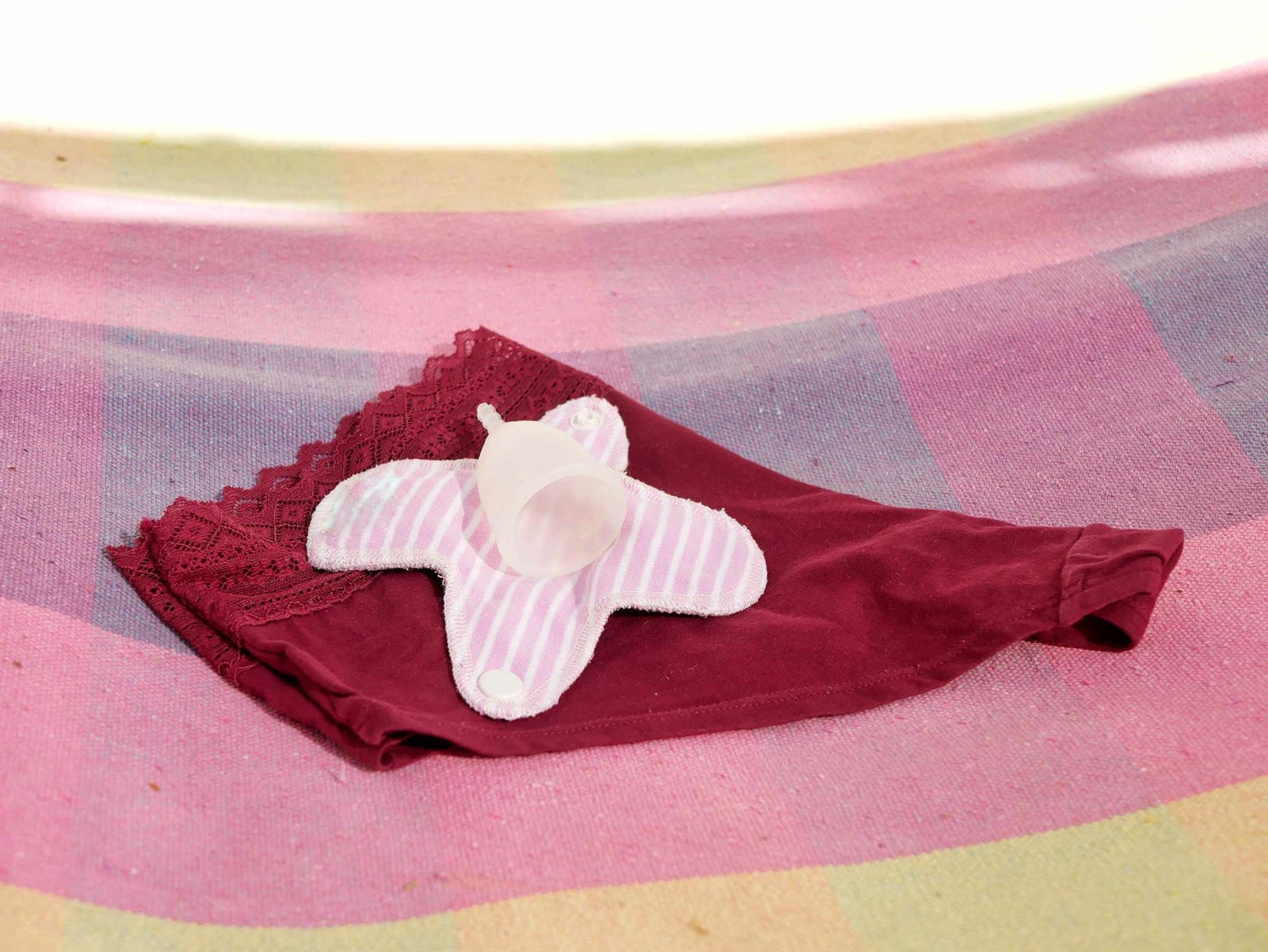
Featured image: “period pants menstrual cup and textile bandage” by Vulvani, CC BY-SA 4.0, via Wikimedia Commons.

Sources
- NHS. Periods. https://www.nhs.uk/conditions/periods/
- NHS. Periods and fertility in the menstrual cycle. https://www.nhs.uk/conditions/periods/fertility-in-the-menstrual-cycle/
- NHS. Period pain. https://www.nhs.uk/symptoms/period-pain/
- NHS. PMS (premenstrual syndrome). https://www.nhs.uk/conditions/pre-menstrual-syndrome/
- NHS. Toxic shock syndrome. https://www.nhs.uk/conditions/toxic-shock-syndrome/
- Cleveland Clinic. Toxic Shock Syndrome. https://my.clevelandclinic.org/health/diseases/15437-toxic-shock-syndrome
- Cleveland Clinic. Premenstrual Syndrome (PMS). https://my.clevelandclinic.org/health/diseases/24288-pms-premenstrual-syndrome
- Cleveland Clinic. Ovulation. https://my.clevelandclinic.org/health/articles/23439-ovulation
- Siddiqui NI, Chinchole S, Khan SA, Bose S, Mishra PK. Study of menstrual cycle synchrony in female medical students sharing common accommodation. J Family Med Prim Care. 2023;12(11):2922-2926. https://pubmed.ncbi.nlm.nih.gov/38186833/
- Schank JC. Menstrual-cycle variability and measurement: further cause for doubt. Psychoneuroendocrinology. 2000;25(8):837-847. https://pubmed.ncbi.nlm.nih.gov/10996477/
- Schank JC. Measurement and cycle variability: reexamining the case for ovarian-cycle synchrony in primates. Behav Processes. 2001;56(3):131-146. https://pubmed.ncbi.nlm.nih.gov/11738507/
- Contou D, Colin G, Travert B, Jochmans S, et al. Menstrual Toxic Shock Syndrome: A French Nationwide Multicenter Retrospective Study. Clin Infect Dis. 2022;74(2):246-253. https://pubmed.ncbi.nlm.nih.gov/33906228/
- Schlievert PM, Davis CC. Device-Associated Menstrual Toxic Shock Syndrome. Clin Microbiol Rev. 2020;33(3):e00032-19. https://pubmed.ncbi.nlm.nih.gov/32461307/