School biology draws the cycle as a tidy circle divided into labelled segments, and real life rarely cooperates. Cycles drift, stretch and sometimes skip altogether. Understanding what each of the four menstrual cycle phases is doing makes those changes easier to read, and it makes the loose timing less alarming. The count starts on day 1, the first day of bleeding, and runs until the day before the next period begins.
Key takeaways
- Day 1 is the first day of real bleeding, so a cycle is counted from bleed to the day before the next bleed.
- Anything from 21 to 35 days is treated as normal by the NHS, while the US Office on Women’s Health calls 24 to 38 days regular.
- Ovulation is better pinned to the next period, about 14 days before it starts, than to day 14 of the current cycle.
- The luteal phase is the steady part at roughly 12 days, while the follicular phase is the one that stretches or shrinks.
- Patterns across the four menstrual cycle phases are easier to see after two or three logged cycles than on any single day.
How cycle days are counted
Day 1 is the first day of proper bleeding, not the light spotting that sometimes comes before it. The cycle ends the day before the next period begins, so a 28-day cycle runs 28 days from bleed to bleed. Every phase boundary is measured against that definition.
What counts as normal depends on who you ask. The NHS describes periods arriving anywhere from every 21 days to every 35 days, while the US Office on Women’s Health calls 24 to 38 days regular and notes that length often differs from month to month. Both are working definitions from different populations rather than one true range.
The average of 28 days is a convenient round number, not a rule. In a study of 612,613 ovulatory cycles logged through an app, the mean was 29.3 days, and length varied from person to person. No calendar month matches the four menstrual cycle phases, so logging your own start dates for a few months tells you more than the textbook figure.
The four menstrual cycle phases, in order
Two hormones do most of the driving, and each of the four menstrual cycle phases is defined by what estrogen and progesterone are doing. The boundaries between them are soft, which is why two people with the same 28-day cycle can feel completely different at day 20.
Days 1 to 5: the menses phase
The cycle begins with bleeding because a pregnancy did not happen, so the lining built for it is no longer needed. Estrogen and progesterone fall to their lowest levels, the lining sheds, and most people bleed for three to five days, though anything from three to seven days is usually nothing to worry about. Bleeding is heaviest on the first two days and lightens after that. If your periods produce large clots or soak through protection quickly, our guide to period blood clots explains where the line sits.
The follicular phase: rebuilding the lining
This stretch overlaps with your period and finishes at ovulation, which makes it the longest and least predictable part of the cycle. Estrogen climbs, follicle-stimulating hormone wakes a group of follicles in the ovaries, and by roughly days 10 to 14 one of them has produced a mature egg.
In the 612,613-cycle study the follicular phase averaged 16.9 days but ranged from 10 to 30. Because the second half of the cycle stays fairly fixed, a late period is usually a late ovulation. Rising estrogen is also why energy tends to come back around this point, the idea behind training with the follicular phase.
Ovulation: the egg leaves
Around the midpoint, a surge of luteinizing hormone makes the ovary release its egg, and that is ovulation. In a textbook 28-day cycle it lands near day 14, which is where the famous number comes from. Clinically it is better anchored to the period that follows, since the NHS says ovulation pain typically shows up about 14 days before a period.
The egg survives roughly 12 to 24 hours, while sperm can live in the uterus for three to five days, so the days before ovulation are the ones that count for conception. The signs are subtle, and tracking them without an app is possible but takes practice.
The luteal phase: the steady stretch
After the egg is released, the empty follicle becomes the corpus luteum and starts producing progesterone. That hormone keeps the uterine lining thick and calm in case a fertilised egg implants. If it does not, both hormones drop, the lining comes away, and the next cycle begins. This stage is the most consistent of the four menstrual cycle phases: in the same large study it averaged 12.4 days, with a range of 7 to 17.
What the phases usually feel like
Articles about the four menstrual cycle phases often describe them as four moods, running from motivated to miserable. Diary studies support something smaller and more individual. In one prospective study, 22 naturally cycling participants and 18 pill users logged symptoms and gave daily saliva samples for 28 days. Hormone levels did track with energy, agitation and feelings of attractiveness, and progesterone showed the largest effect, but 22 people is a thin sample to generalise from.
Premenstrual symptoms are common and well documented. The Office on Women’s Health lists cramping, headaches, moodiness, forgetfulness, bloating and breast tenderness, all of which tend to build before bleeding starts and ease once it does. Asthma and irritable bowel symptoms can shift with the cycle too, so a rough week is not automatically hormonal. There is more in our Cycle & Fertility archive if you want to go deeper.
Keeping your own record beats trusting a chart. Note your bleeding days, energy and mood for two or three cycles and the pattern will surface on its own, including the stretch where you need more rest. If you want to eat around the cycle, our phase-by-phase food guide covers what tends to help at each stage.
When to see a doctor
NHS guidance separates what can wait from what should be checked. Bleeding between periods, bleeding after sex, or any bleeding after menopause should be looked at by a doctor, and so should a cycle that has changed and stayed changed. See a GP if you have missed three periods in a row and a pregnancy test is negative. Severe pain or bleeding that makes you miss work or school is treatable, so raise it rather than push through it.
How Lail can help
Lail is our own period tracker for Android, built around one idea: your data stays on your phone, with no account and no cloud sync. You can log bleeding, symptoms, mood and weight, then watch your own phases line up over a few months instead of comparing yourself to a diagram. Premium adds a PDF export that is genuinely useful to bring to an appointment. Lail is on Google Play, and the rest of our apps are listed on the products page.
Is ovulation always on day 14?
No. Day 14 is the average for a 28-day cycle and nothing more. Ovulation is better estimated as about 14 days before the next period, which is why the date slides when a cycle runs longer or shorter.
Which phase leaves you most tired?
The last days of the luteal phase and the first days of bleeding are when energy usually dips, because estrogen and progesterone are both falling. That pattern is common, but the four menstrual cycle phases do not come with fixed moods. If tiredness is severe or comes with heavy bleeding, ask a doctor about checking your iron levels.
How long should a period last?
Two to seven days, with about five being typical, according to the NHS. Total blood loss usually falls between 20 and 90 ml, and bleeding is heaviest on the first two days. If your periods have been getting longer or heavier than your normal, that is worth a conversation with a GP.
Can I use a tracking app to avoid pregnancy?
Do not rely on it. An analysis of 543,167 cycles found calendar-based tracking flagged at least one fertile day as safe in 67% of cycles, with an estimated pregnancy risk of 22%. If you are trying to avoid pregnancy, use a method with proper evidence behind it.
This article is educational and does not replace advice from a qualified healthcare professional. If something about your cycle worries you, talk to a doctor.
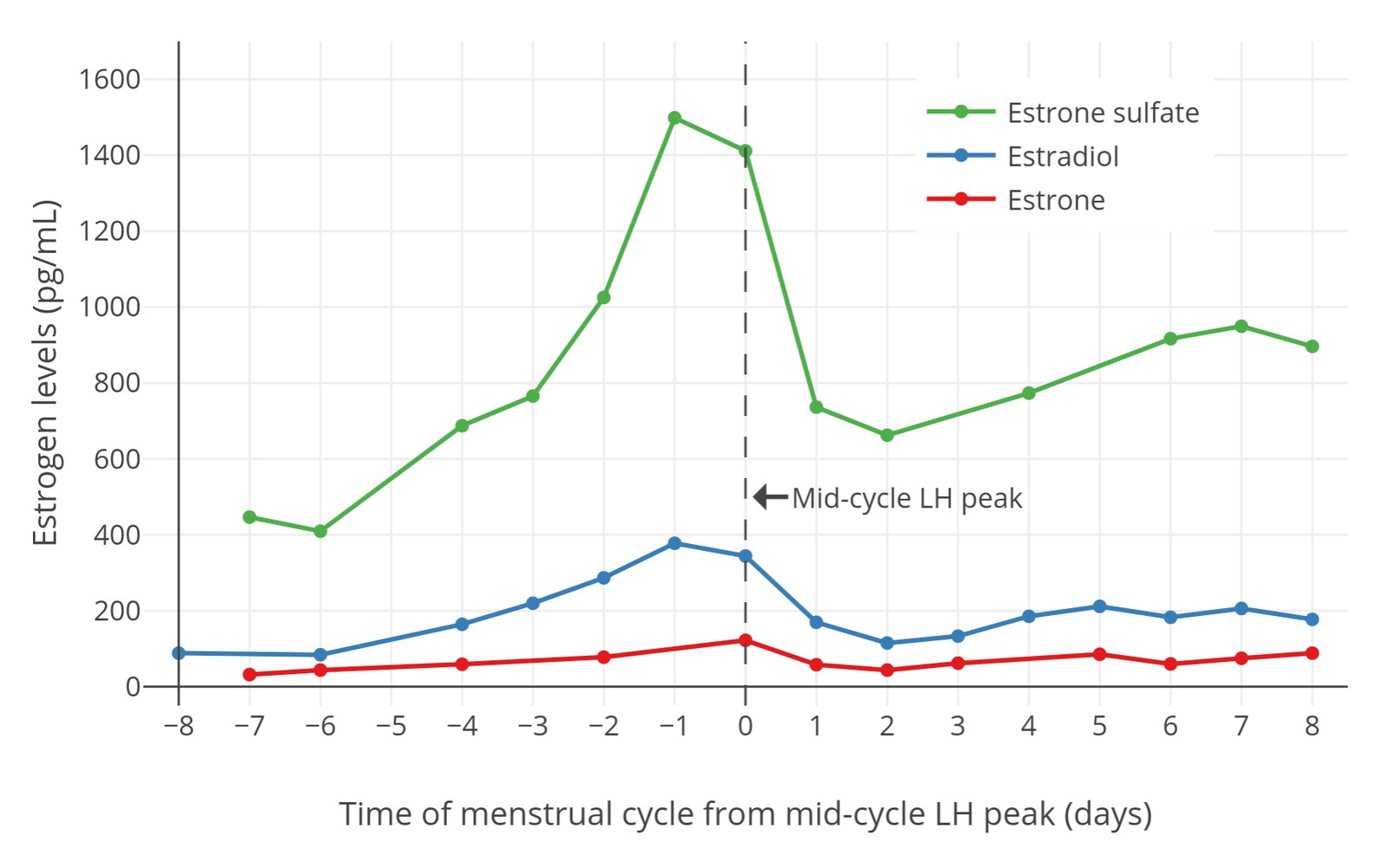
Featured image: estradiol, estrone and estrone sulfate levels across the normal human menstrual cycle, by Medgirl131 via Wikimedia Commons, licensed under CC BY-SA 4.0.
Sources
- NHS. Periods. https://www.nhs.uk/conditions/periods/
- NHS. Ovulation pain. https://www.nhs.uk/symptoms/ovulation-pain/
- Cleveland Clinic. Menstrual cycle (normal menstruation): overview and phases. https://my.clevelandclinic.org/health/articles/10132-menstrual-cycle
- Cleveland Clinic. Ovulation: calculating, process, pain and other symptoms. https://my.clevelandclinic.org/health/articles/23439-ovulation
- Office on Women’s Health, US Department of Health and Human Services. Your menstrual cycle. https://womenshealth.gov/menstrual-cycle/your-menstrual-cycle
- Bull JR, Rowland SP, Scherwitzl EB, et al. Real-world menstrual cycle characteristics of more than 600,000 menstrual cycles. NPJ Digital Medicine, 2019. https://pubmed.ncbi.nlm.nih.gov/31482137/
- Doornweerd AM, Gerritsen L. 28 days later: a prospective daily study on psychological well-being across the menstrual cycle and the effects of hormones and oral contraceptives. Psychological Medicine, 2025. https://pubmed.ncbi.nlm.nih.gov/39917827/
- Brondolin E, Hadengue B, Perro D, et al. Fertile-window misclassification in period-tracking applications and associated pregnancy risk. European Journal of Contraception and Reproductive Health Care, 2026. https://pubmed.ncbi.nlm.nih.gov/42145202/
Leave a Reply