One morning the coffee that has started your day for a decade smells like something burning, and the thought of it is enough to drive you out of the kitchen. Food aversions often arrive before anyone else knows you are expecting, and their intensity can feel wildly out of proportion to what is actually happening. So when people describe smell sensitivity during pregnancy as a kind of superpower, it is worth separating what you feel from what researchers have actually measured, because the two do not line up neatly. The experience is real and very common, and there is a lot you can do about it. Taste can shift in early pregnancy too, which is why a metallic taste in your mouth often shows up in the same weeks.
Key takeaways
- Up to 80% of people who are pregnant get nausea, and smells are one of the most common triggers.
- A 2022 meta-analysis of 13 studies found pregnant women did not have lower odor detection thresholds than non-pregnant women.
- The same analysis found pregnant women were worse, not better, at identifying odors.
- Hormones, especially hCG and progesterone, are the suspected culprits, and symptoms usually peak between weeks 8 and 10.
- What holds up in practice: avoid strong odors, eat cold or bland food, snack often, and try ginger or acupressure.
Why smell sensitivity during pregnancy is real
Nobody has pinned down the exact mechanism. Cleveland Clinic reports that doctors suspect surging human chorionic gonadotropin (hCG) and progesterone, the same hormones that climb steeply in early pregnancy. The NHS puts it more simply: hormonal changes in the first 12 weeks are probably one of the causes of morning sickness.
The timing backs that up. Nausea usually builds between weeks 8 and 10 and eases by around week 16, which tracks the hormone curve of early pregnancy. That curve also explains why smell sensitivity during pregnancy is worst in the first trimester, when those hormones are climbing fastest.
Congestion plays a part too. Pregnancy rhinitis swells the lining of the nose and narrows the airway, and a 2025 controlled study of 50 women in their third trimester against 25 non-pregnant controls found the pregnant group scored lower on detection, discrimination and identification using Sniffin’ Sticks tests. About half of them had measurable olfactory disturbance, and most had not noticed it.
Does pregnancy really sharpen your nose?
This is where the popular story and the evidence part ways. A 2022 systematic review and meta-analysis in Chemical Senses pooled 13 studies, and nine were detailed enough to combine, covering 523 pregnant women and 365 controls.
The result is blunt. The authors found no significant differences between pregnant and non-pregnant women in odor discrimination, detection thresholds, or hedonics, which is how pleasant or unpleasant a smell seems. What they did find, in a meta-analysis of 506 cases and 333 controls, was worse odor identification during pregnancy.
So the honest position on smell sensitivity during pregnancy is that odor intolerance is real and common, even though the lab measurements do not show a sharper nose. It looks more like the same smells landing differently, with nausea and aversion amplifying the response, rather than a genuinely heightened sense of smell. The authors note that gap themselves, between widespread subjective reports of hypersensitivity and what objective testing shows.
What helps when smells make you queasy
Managing smell sensitivity during pregnancy comes down to reducing exposure rather than retraining your nose. The NHS recommends avoiding foods or smells that make you feel sick, and suggests cold foods over hot ones when the smell of a hot meal sets you off. That one change helps more than people expect, because cooking smells travel much further than the food itself.
Eating little and often is the other big lever. An empty stomach makes nausea worse, so Cleveland Clinic suggests small meals or snacks every few hours, and keeping starchy food such as crackers on hand to soak up gastric acid. Protein-rich snacks like yogurt, nuts and cottage cheese are worth prioritizing, because they give longer-lasting relief than foods high in carbohydrate or fat.
Four things worth trying first:
- Eat cold or room-temperature meals when cooking smells are the problem.
- Keep crackers or nuts nearby and snack every few hours instead of waiting for a full meal.
- Try ginger, which the NHS says has some evidence for reducing nausea.
- Ask your midwife or pharmacist before taking any supplement, including ginger capsules.
A motion sickness band, or light pressure on the P6 point on the inside of your wrist, is another option the NHS lists alongside its lifestyle advice, and it costs nothing to test.
Hydration needs its own juggling act. Dehydration makes nausea worse, but a very full stomach does not help either, so sipping little and often works better than large glasses. If your prenatal vitamin seems to be part of the problem, Cleveland Clinic suggests taking it in the evening with a small snack.
Handling smells you cannot escape
Some triggers are impossible to dodge, especially at work, on public transport or in someone else’s kitchen. Putting a scent you enjoy on a cotton ball gives you something else to smell, and Cleveland Clinic suggests chamomile, ginger, lemon, orange or peppermint, with the sensible caveat that any of them can backfire. Fresh air and an open window do more work than they get credit for.
Small timing changes help as well. Brushing your teeth straight after eating can set off a gag reflex, so waiting around 30 minutes is kinder. Lying down after a meal lets stomach juices rise, which makes queasiness worse, so staying upright for a while is worth the effort.
When to call your midwife or GP
Ordinary smell aversion is unpleasant but not dangerous. Severe nausea and vomiting is a different matter, and roughly 1% to 3% of pregnant women develop hyperemesis gravidarum, which can cause dehydration, electrolyte imbalance and poor nutrition, and sometimes needs a hospital stay.
Contact your midwife, GP or maternity unit if you cannot keep food or drink down for 24 hours, if you are losing weight, or if you have abdominal pain, a fever, difficulty urinating, or blood in your vomit. Dark urine that smells stronger than usual can point to dehydration. Anti-sickness medicines that are safe in pregnancy exist, so persistent symptoms are worth asking about rather than just enduring.
A weakening or loss of smell is a different picture from sensitivity, and worth mentioning separately. Both the rhinitis study and a 2025 study of postpartum women found measurable smell loss around pregnancy, so a nose that has gone quiet deserves a conversation rather than a shrug.
Early pregnancy brings plenty of other oddities too, from frequent urination to back pain, and they are easier to handle once you know what is behind them.
How Utun can help
Utun is a pregnancy companion that matches its development information and daily guidance to how far along you are, so you get advice for the stage you are actually in rather than for pregnancy in general. Its health trackers include a weight log, a kick counter and a contraction timer, and there is a mood journal for the days when nausea wears you down. See it at utunapp.nayabisa.com or get Utun on Google Play.
FAQ
How early does smell sensitivity start in pregnancy?
Most people notice it in the first trimester, often before they have told anyone the news. Nausea tends to build between weeks 8 and 10 and eases by around week 16, and food aversions usually follow the same curve. Some people notice changes even earlier than that.
Is a strong sense of smell a sign you are having a girl?
There is no reliable evidence that smell changes predict your baby’s sex. The idea circulates widely, but the 2022 meta-analysis found no difference in detection thresholds between pregnant and non-pregnant women, never mind between pregnancies carrying boys and girls. Treat it as a fun theory rather than a test.
Does smell sensitivity mean a healthy pregnancy?
Smell sensitivity during pregnancy is not a sign of a healthy or unhealthy pregnancy. It is simply a common symptom of early pregnancy, and plenty of people never get nausea at all. What matters is whether you can keep fluids down and stay nourished.
What smells should I avoid in pregnancy?
There is no fixed list, because triggers are personal. Common ones include hot cooking smells, coffee, perfume, petrol and cigarette smoke. The NHS advice is to avoid whatever makes you feel sick, and to eat cold rather than hot food when cooking smells are the problem.
Can I use essential oils for nausea?
Cleveland Clinic suggests sniffing a few drops of chamomile, ginger, lemon, orange or peppermint oil on a cotton ball. Keep it to smelling rather than swallowing, and stop if a scent makes you feel worse. Ask your midwife before putting any essential oil on your skin.
This article is educational and is not medical advice. Talk to your midwife, doctor or pharmacist about your own symptoms, and check with them before taking any supplement or medicine during pregnancy.
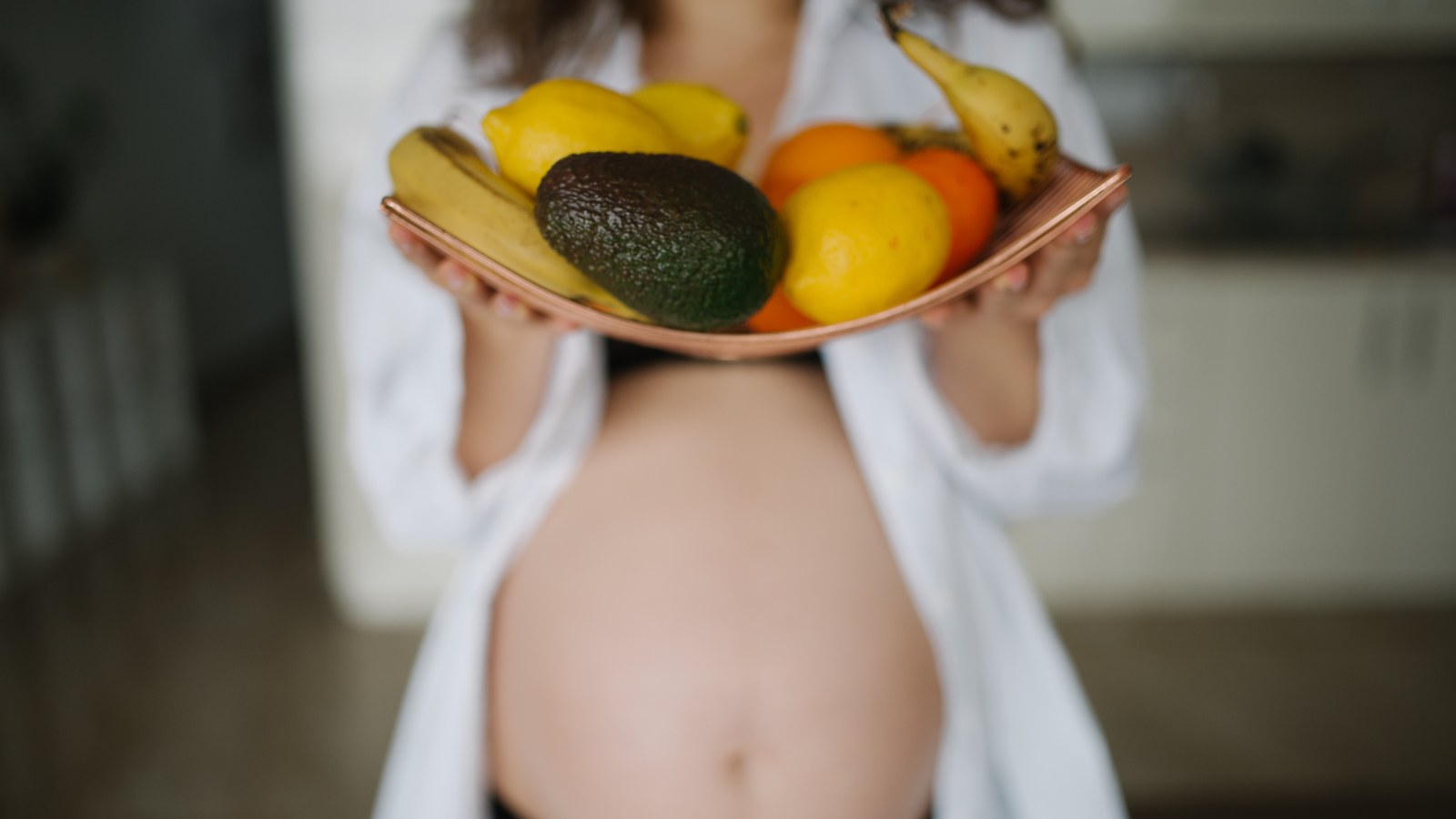
Featured image: “Pregnant woman holding a plate of fresh fruits in a modern kitchen” by Shixart1985, CC BY 2.0, via Wikimedia Commons.
Sources
- NHS. Vomiting and morning sickness. https://www.nhs.uk/pregnancy/related-conditions/common-symptoms/vomiting-and-morning-sickness/
- Cleveland Clinic. Morning Sickness? 12 Remedies That Really Work. https://health.clevelandclinic.org/morning-sickness-10-tips-to-tame-your-turbulent-tummy-day-or-night
- Cleveland Clinic. Is My Morning Sickness ‘Normal’? https://health.clevelandclinic.org/is-my-morning-sickness-normal
- Albaugh SL, Wu LL, Zhang D, et al. Olfaction in pregnancy: systematic review and meta-analysis. Chemical Senses. 2022. https://pubmed.ncbi.nlm.nih.gov/36469055/
- Sobczyk K, Grajczyk A, Żaman K, et al. Impact of Pregnancy Rhinitis on Olfactory Sensitivity: A Controlled Comparative Study. Diagnostics. 2025. https://pubmed.ncbi.nlm.nih.gov/41153244/
- Jacobson PT, Arduin E, Hussain M, et al. Prevalence of olfactory dysfunction among postpartum women and impact of SARS-CoV-2 infection during pregnancy. Chemical Senses. 2025. https://pubmed.ncbi.nlm.nih.gov/40258799/
Leave a Reply